The Retention Protocol: Watch Time Mechanics for Music Channels
On YouTube, the recommendation engine reads one signal above all others: whether people keep watching. Here is the full retention build for music video — visual dynamics, loop mechanics, the first fifteen seconds, packaging, and session-time architecture — stated as working rules for the study, chill, and focus ecosystem.

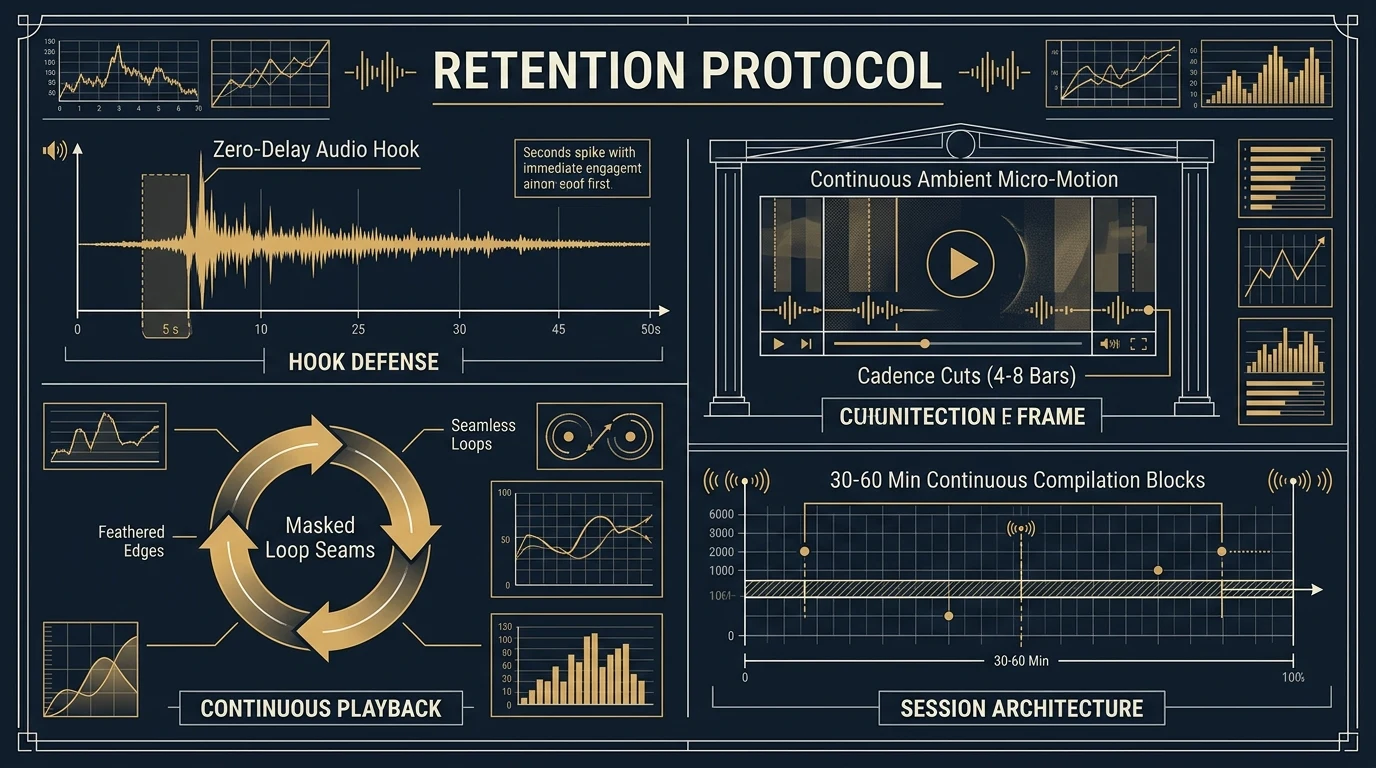
The one metric that is the whole game
Companion: The mechanics half of The YouTube Lane for AI and Hybrid Music → — read that piece for why this lane and the pipeline that feeds it; this one is pure execution.
YouTube’s recommendation engine promotes on engagement, and for music video the engagement signal that matters is retention — watch time and Average Percentage Viewed. Everything in this protocol serves that single number. A note on epistemics before the rules: these are field heuristics for the instrumental, ambient, and hybrid ecosystem — working rules the practitioners of this space converge on, not sourced statistics. Your channel analytics are the only authority that outranks them; test everything here against your own retention curves.
The governing principle: pair acoustic energy with continuous visual micro-motion, and package the video around listener utility rather than your catalog’s naming conventions. Every rule below is that sentence, applied.
Visual dynamics and loop mechanics
Layer micro-motion onto every frame. A looping visualizer with a genuinely static image reads to the viewer’s nervous system as “nothing is happening,” and the hand answers with the close button. Continuous ambient movement defeats the instinct: falling rain, drifting dust motes, passing car reflections, breathing neon. The motion doesn’t need narrative content — it needs to certify, at every moment, that the frame is alive.
Cut on musical cadence. For generated narrative clips, change camera angle or perspective every four to eight bars — roughly eight to sixteen seconds at common tempos — and land scene transitions on beat drops, chorus entries, and rhythmic shifts. This is where a producer’s training becomes the moat: the flood cuts its video against arbitrary timecode, and viewers feel the mismatch without being able to name it. Treat the edit as part of the arrangement, because it is. The transition schedule is a rhythm part; write it like one.
Mask the loop seam like a craftsman. The repeat point is where a loop video dies, because the moment a viewer detects it, the spell of continuity breaks. Two proven masks: cross-dissolved motion blur at the seam, or a symmetrical environmental cycle — the train-window construction, where passing scenery blurs into itself and the loop has no perceptible beginning. Budget real craft time here; the seam is the difference between a one-hour asset and a three-minute one wearing a one-hour costume.
The first fifteen seconds: drop-off defense
Zero-delay audio hook. The core groove or melodic identity of the track lands within the first three to five seconds. The twenty-second ambient fade-in — beloved of producers, lethal on this platform — is the most common self-inflicted wound on music channels, and the field’s consistent observation is that it drives the majority of immediate abandonment. The listener arrived mid-decision: is this the sound of the next hour of my life? Answer instantly.
Immediate scene establishment. The visual obeys the same clock. Open on a dynamic establishing shot with high contrast — the atmosphere declared in the first frame, not developed toward. Mood recognition is the product being sold in those seconds; sell it before the viewer’s thumb finishes its judgment.
Packaging: the click before the watch
Title for utility and mood, never for track names. Nobody searches an unknown artist or a catalog number. They search the activity, the genre, the feeling:
High-performing: Late Night Coding in Neo-Tokyo | Dark Cyberpunk & Synthwave Mix
Low-performing: Neon City — Synth Track 04 (Original AI Music)
The first title answers the searcher’s only question — does this fit what I’m about to do? The second answers a question nobody asked. Your artist identity gets built downstream: channel page, descriptions, end cards — after utility has done the acquisition.
Thumbnails: one subject, high contrast, no text. A solitary figure at a glowing terminal. A rain-streaked coffee-shop window. Wordless, cinematic, single-subject frames consistently out-click cluttered scenes and text overlays across the study, chill, and focus genres — because the thumbnail’s job is mood transmission at a glance, and imagery is faster than reading.
Session-time architecture
Bundle into thirty-to-sixty-minute compilations. A three-minute single caps its own watch-time contribution no matter how well it retains. Chain eight to fifteen cohesive tracks into a continuous themed mix, and even a partial viewer contributes fifteen to twenty-five minutes of watch time — the cumulative signal the recommendation engine reads as authority. The craft requirement hiding inside the tactic: cohesive is load-bearing. A mix that lurches between moods resets the viewer’s decision to stay every time it lurches. Sequence the hour the way you’d sequence a record, because that discipline — an album’s worth of coherence — is precisely what the flood cannot fake.
The protocol on one page
Micro-motion on every frame. Cuts on the cadence, four to eight bars. Seams masked. Hook inside five seconds. Atmosphere in the first shot. Titles for the listener’s moment. Thumbnails wordless, single-subject. Hours, not singles — sequenced like records. And underneath all of it, the standing doctrine from the Lane piece →: disclose the AI, log the tools, and let human curation be the thing the retention curve proves.