Desk
Craft
Craft Desk The Camera or the Clone: How Platforms Actually Rule AI Video  Every major platform now labels AI video — increasingly whether you disclose it or not. The verified rulebook for YouTube, TikTok, and Meta, the regulatory layer underneath, and the framework for deciding when your real face is the asset and when a digital twin can take the shift. Craft Desk The Feed Is Not the Destination: Converting Generative-Platform Traction
  In-app plays on generative platforms pay nothing — the feed is top-of-funnel, and everything downstream is where the money lives. The conversion architecture, built properly — starting with the correction most guides miss: Suno and Udio are no longer the same kind of platform, and one of them is a garden you can't carry anything out of. Craft Desk The Retention Protocol: Watch Time Mechanics for Music Channels
 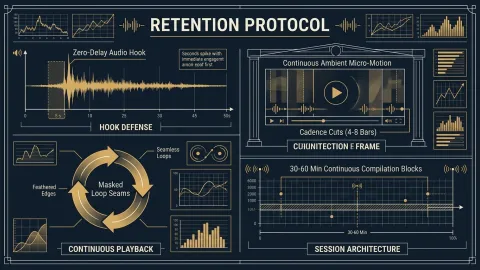 On YouTube, the recommendation engine reads one signal above all others: whether people keep watching. Here is the full retention build for music video — visual dynamics, loop mechanics, the first fifteen seconds, packaging, and session-time architecture — stated as working rules for the study, chill, and focus ecosystem. Craft Desk The YouTube Lane for AI and Hybrid Music: The Full Build
  The payout map said it: for AI-touched music, the pro-rata pool is the wrong pond, and video-wrapped YouTube is the deepest alternative lane. Here is the lane's strategy, from bounce to upload — why it works, the multimodal pipeline that feeds it, and the doctrine obligations attached. The execution mechanics live in its companion, The Retention Protocol. The Craft Desk · Signed essay Editor's Pick I Had Never Produced a Country Song
  Then I produced one, in a single attempt, and the client said it was incredible. Here is what the machine actually taught me — why a generative tool is a better teacher than a blank DAW, what it can't teach at all, and the one question that turns it from a toy into a school. The Craft Desk · Vocal Production The Vocal Producer's Real Job: Coaching, Not Patching
  Every guide teaches the chain — mic, preamp, compressor, tune. Almost none teach the thing that actually decides the record: what you say to a singer between takes, and what you do with the takes afterward. The two halves of a job that has quietly become one. The Craft Desk · Reference Who Does What — and What It Pays
  Ten roles, constantly confused with each other. What each one actually does, what each one owns, who proved its worth — and, the part nobody publishes, how each one actually gets paid. Some of these jobs are paid once. Some are paid for forty years. Almost nobody chooses deliberately between them. Craft Mastering Loudness in 2026: Streaming Targets, Tested
  "-14 LUFS or the algorithm punishes you" is the most repeated — and most dangerously outdated — sentence in home mastering. What normalization actually does, what actually matters, and the tests to run on your own masters. Economics of the Craft Registering Your Royalties Without Giving Up a Cut: PRO, MLC, and SoundExchange
  Three organizations collect money your music is already earning — and most independents are registered with one, none, or a middleman taking a percentage for paperwork. The full self-administration map. Craft Mixing Yourself Without Lying to Yourself
 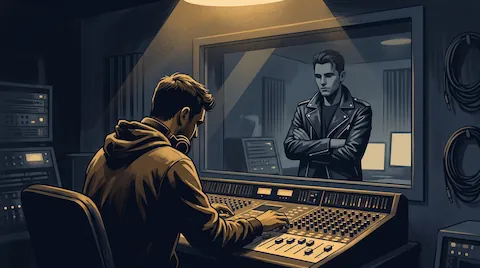 The hardest mix engineer to work with is the one who also wrote, sang, and produced the record. A working framework for the psychological problem underneath every self-mixed track. Craft Stem-Separation Artifacts: Making Extracted Audio Sit in a Commercial Mix
  AI stem separation went from party trick to daily tool — but the artifacts ride along. A working method for hiding phase smear, ghost bleed, and the swirl, plus the honest line on when extracted stems belong in a master at all.
Every major platform now labels AI video — increasingly whether you disclose it or not. The verified rulebook for YouTube, TikTok, and Meta, the regulatory layer underneath, and the framework for deciding when your real face is the asset and when a digital twin can take the shift. Craft Desk The Feed Is Not the Destination: Converting Generative-Platform Traction In-app plays on generative platforms pay nothing — the feed is top-of-funnel, and everything downstream is where the money lives. The conversion architecture, built properly — starting with the correction most guides miss: Suno and Udio are no longer the same kind of platform, and one of them is a garden you can't carry anything out of. Craft Desk The Retention Protocol: Watch Time Mechanics for Music Channels On YouTube, the recommendation engine reads one signal above all others: whether people keep watching. Here is the full retention build for music video — visual dynamics, loop mechanics, the first fifteen seconds, packaging, and session-time architecture — stated as working rules for the study, chill, and focus ecosystem. Craft Desk The YouTube Lane for AI and Hybrid Music: The Full Build The payout map said it: for AI-touched music, the pro-rata pool is the wrong pond, and video-wrapped YouTube is the deepest alternative lane. Here is the lane's strategy, from bounce to upload — why it works, the multimodal pipeline that feeds it, and the doctrine obligations attached. The execution mechanics live in its companion, The Retention Protocol. The Craft Desk · Signed essay Editor's Pick I Had Never Produced a Country Song Then I produced one, in a single attempt, and the client said it was incredible. Here is what the machine actually taught me — why a generative tool is a better teacher than a blank DAW, what it can't teach at all, and the one question that turns it from a toy into a school. The Craft Desk · Vocal Production The Vocal Producer's Real Job: Coaching, Not Patching Every guide teaches the chain — mic, preamp, compressor, tune. Almost none teach the thing that actually decides the record: what you say to a singer between takes, and what you do with the takes afterward. The two halves of a job that has quietly become one. The Craft Desk · Reference Who Does What — and What It Pays Ten roles, constantly confused with each other. What each one actually does, what each one owns, who proved its worth — and, the part nobody publishes, how each one actually gets paid. Some of these jobs are paid once. Some are paid for forty years. Almost nobody chooses deliberately between them. Craft Mastering Loudness in 2026: Streaming Targets, Tested "-14 LUFS or the algorithm punishes you" is the most repeated — and most dangerously outdated — sentence in home mastering. What normalization actually does, what actually matters, and the tests to run on your own masters. Economics of the Craft Registering Your Royalties Without Giving Up a Cut: PRO, MLC, and SoundExchange Three organizations collect money your music is already earning — and most independents are registered with one, none, or a middleman taking a percentage for paperwork. The full self-administration map. Craft Mixing Yourself Without Lying to Yourself The hardest mix engineer to work with is the one who also wrote, sang, and produced the record. A working framework for the psychological problem underneath every self-mixed track. Craft Stem-Separation Artifacts: Making Extracted Audio Sit in a Commercial Mix AI stem separation went from party trick to daily tool — but the artifacts ride along. A working method for hiding phase smear, ghost bleed, and the swirl, plus the honest line on when extracted stems belong in a master at all.