The Hall of Records · The Masters Editor's Pick
The Masters: Tom Dowd
He did nuclear research on the Manhattan Project as a teenager, then walked away from physics and spent fifty years recording Ray Charles, Aretha Franklin, Coltrane, and Clapton — inventing the modern console along the way. The most improbable road in the Hall, and the deepest lesson.

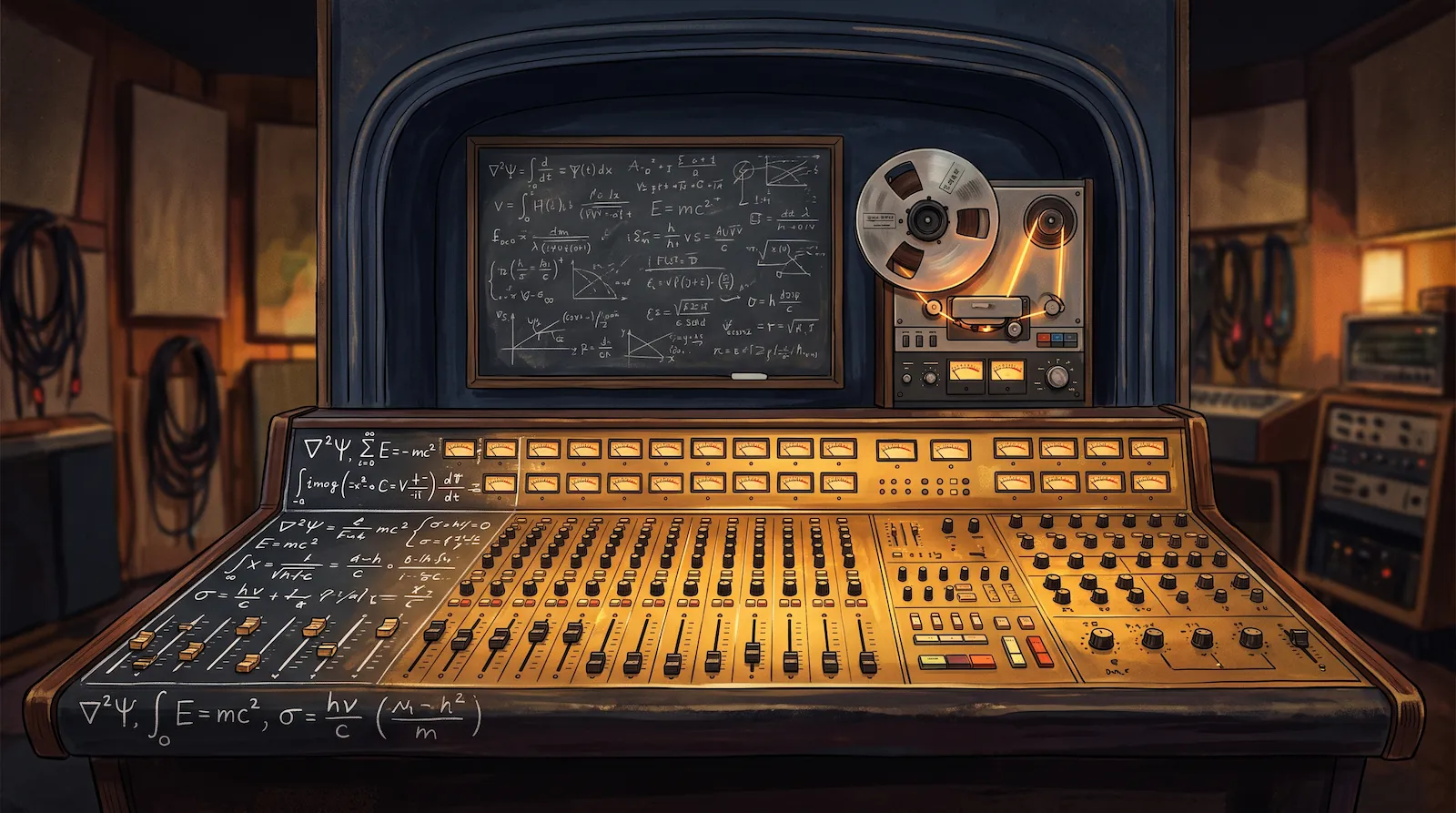
Every time you touch a fader — hardware or on a screen, today, this session — you are using Tom Dowd’s idea. Almost nobody at the world’s ten million mixing desks knows his name, which is exactly the kind of injustice The Hall of Records was built to correct, because the story behind that fader may be the single most improbable biography in the history of recorded music: the man who designed the modern console’s defining gesture spent his teenage years doing nuclear research on the Manhattan Project.
That is not a colorful exaggeration. It is the documented, verified, almost absurd truth — and it’s only the opening of the road.
The record
Run the discography and it stops reading like a résumé and starts reading like a curriculum of American music itself. At Atlantic Records, where Dowd served as house engineer through the label’s imperial decades, he recorded Ray Charles — including “What’d I Say,” cut live to the room’s energy in a session that became legend. He recorded Aretha Franklin in her Atlantic prime — “Respect” passed through his hands. He captured John Coltrane’s Giant Steps: the harmonic Everest of modern jazz, documented for eternity by the same man who’d spend the next decade recording rock and roll. Then the British and Southern chapters: Cream at their psychedelic peak, Derek and the Dominos — where Dowd engineered “Layla” and helped assemble its famous two-part architecture — Lynyrd Skynyrd, the Allman Brothers, Rod Stewart, Otis Redding. Soul, jazz, blues-rock, Southern rock: four or five separate canons, one engineer.
No modern career could replicate that spread, because no modern label sits where Atlantic sat — but that’s precisely what makes the record instructive rather than merely impressive. Dowd wasn’t a genre specialist who got lucky repeatedly. He was a methodologist whose method worked on anything: understand the physics completely, then make the physics disappear in service of the performance. Which brings us to the method — and to why he understood the physics better than anyone alive.
The method
Physics meets soul. Dowd walked into recording studios with a working knowledge of electronics and signal that, in the 1940s and ’50s, essentially no one else in music possessed — and instead of wielding it as gatekeeping, he spent five decades converting it into invisibility: tools and techniques whose entire purpose was getting the machine out of the performance’s way. Three of his innovations are so universal they’ve become anonymous:
The linear fader — the console’s defining gesture. The consoles Dowd inherited controlled volume with rotary knobs: one hand, one channel, two at best. Dowd replaced them with linear slide faders — and the change rewired what mixing is. Ten fingers could now ride ten channels simultaneously, and Dowd did exactly that, playing the console like the instrument his innovation had just made it: riding balances live, during the performance, sculpting the record in real time rather than flattening dynamics afterward with heavy compression. Watch any engineer today — hands spread across a surface, or a mouse dragging a fader lane — and you are watching Dowd’s idea. It is one of the very few interface decisions in any field to survive seventy-plus years essentially unchanged, because it was simply correct.
The multitrack future, early. Dowd was among the earliest and most forceful advocates of multitrack recording and multi-microphone isolation — pushing Atlantic to install eight-track capability when much of the industry considered stereo itself a novelty. The physicist understood before nearly anyone what separated, independently controllable signals would make possible: the entire subsequent history of record production, essentially, lives downstream of that bet. Every overdub, every isolated vocal chain, every stem — the whole architecture this magazine teaches — runs on the future Dowd argued for decades early.
The performance-first ethic. And here’s what keeps the innovations from being merely technical trivia: everything served the take. The fader rides existed so dynamics could stay alive. The isolation existed so a great performance wouldn’t be held hostage by a bad bleed. The physics existed so that when Aretha happened — and in Dowd’s rooms, Aretha kept happening — the machine would already be invisible. If that hierarchy sounds familiar, it’s because it is the universal mindset of the entire Hall →: servant of the song, arrived at, in Dowd’s case, by way of quantum mechanics.
What a working producer should steal: Dowd’s advantage wasn’t gear — it was understanding one layer deeper than everyone else in the room, then spending that understanding entirely on the music. In this era that translates directly: the producer who actually understands gain staging, phase, and the signal path — rather than cargo-culting presets — holds Dowd’s exact edge, scaled to a laptop. Depth of understanding is the one piece of equipment that has never once been commoditized.
The road
Here is the origin story no screenwriter would dare pitch.
Thomas Dowd was a physics prodigy in New York — Stuyvesant, then Columbia — and during the Second World War, still a teenager, he was assigned to the Manhattan Project, performing nuclear research inside the program that built the atomic bomb. Before he was old enough to vote, Tom Dowd had worked on the most consequential physics project in human history.
Then the war ended — and the door closed in the cruelest bureaucratic way possible. The work was classified. He couldn’t cite it, couldn’t publish it, couldn’t build the academic physics career his experience should have guaranteed; the university curriculum available to him now lagged behind what he had already done in secret. The path forward in physics was, absurdly, blocked by his own achievements’ invisibility.
So he chose music. The consolation career. The fallback.
Hold that fact against everything that followed: the fallback produced “Respect” and Giant Steps and “Layla” and the console under every engineer’s hands on earth. The man who helped split the atom spent the next fifty years making sure the machine never got between a human being and a feeling — and by every account was among the most beloved figures ever to sit behind glass, the rare technical giant remembered first for his warmth. He worked essentially to the end: Dowd died in 2002, months after completion of the documentary that finally made his name public — Tom Dowd & the Language of Music, required viewing for every reader of this desk, and as close to a founding text as the craft-behind-the-curtain possesses.
For the working producer, the road teaches in two directions at once. First: nobody’s background is wrong for this work. The Hall’s first two profiles are a jazz guitarist with 240 number ones → and a nuclear physicist with “Layla” — neither entered through the front door, because there has never actually been a front door. Second, and closest to this masthead’s heart: Dowd is the original, unanswerable proof of the house’s oldest claim — deep technical mastery doesn’t compete with soul. It’s what soul sounds like when it can finally be heard.
The legacy
Twenty-plus years gone, Dowd’s fingerprints remain on every session anyone runs: every fader ride, every isolated source, every engineer who thinks in signal and feel simultaneously. The multitrack world he argued into existence became the water every producer swims in; the fader became the gesture that means “mixing” in every language. And the deeper legacy is the template he set for what this desk honors — the figure who knows the most and shows it the least, whose mastery is measured in how completely it disappears into other people’s greatness.
The records said Ray Charles, Aretha, Coltrane, Clapton. The Hall of Records exists to say the other name.
The Hall of Records: The Five Schools → · The Electronic Visionaries →: Serban Ghenea