The Hall of Records · The anchor Editor's Pick
The Pantheon: The Greatest Record Producers and How They Actually Thought
The definitive map of production's highest echelon — not a ranking, a taxonomy. Eighteen era-defining producers across three wings, each distilled to the operating philosophy that made them, and the universal mindsets they all share.


I. Why a taxonomy and not a ranking
The pantheon of record production is the small set of producers, engineers, and composers who defined eras of music rather than participated in them — and the striking fact about them, studied together, is that their techniques share almost nothing while their thinking shares almost everything. At the highest echelon, the work completely transcends technical mechanics: the figures below share mindsets rooted in psychology, structural vision, and sonic architecture — not gear. This page is the definitive map: not a ranking (rankings are entertainment; taxonomy is education) but the highest room in the craft organized into three wings, each name distilled to its operating philosophy — with the deeper essays and full profiles of this desk hanging off every entry as the Hall grows.
II. Wing one: the Architects & Minimalists
The builders of pop, soul, R&B, and rock’s defining records — philosophies forged in rooms full of players.
Quincy Jones — the Architect. Uncompromising synthesis and casting. Jones didn’t just produce records; he built cultural monuments — jazz sophistication applied to pop, R&B, and soul without ever losing accessibility. He treated the control room as an architectural casting office: gather exactly the right arrangers, session players, and engineers, hang the famous “Leave your ego at the door” banner, and maintain an elevated thirty-thousand-foot vision while masters do their best work. The arrangement discipline matched the casting: in the Jones school, brass and rhythm lines never occupy the pitch or rhythmic space of the lead vocal — they react strictly in the gaps. The lesson: your taste in people and parts is a production instrument — sometimes the primary one.
Rick Rubin — the Reducer. Extreme subtraction and psychological safety. Rubin is the antithesis of the technical producer — he often doesn’t touch the board at all. His core stress test requires artists to perform tracks on a single acoustic instrument; if the raw composition fails to move the room, no amount of production is applied. From there he systematically mutes non-essential tracks — if a layer isn’t actively enhancing the emotional arc, it’s gone — and engineers the environment itself: control rooms turned into living spaces, equipment lights and time constraints removed, to induce an uninhibited flow state where artists forget they’re being recorded. The lesson: production’s first job is removing everything between the listener and the emotion — including, frequently, the producer.
George Martin — the Innovator. The studio as a compositional instrument. Before Martin, the studio was purely a place to document a live performance; with The Beatles, he proved the studio itself was an instrument. Formal training met fearless experimentation: string quartets walking into rock music, varispeed tracking (recording slow so playback returns bright, tight, and otherworldly), tape loops cut with razor blades, thrown in the air, and spliced back at random into sonic collage — sounds that were physically impossible to play, composed into existence at the desk. The lesson: every generation gets a technology the last one calls cheating; the Martins of each era treat it as an instrument and author with it. the Bionic doctrine →
Max Martin — the Scientist. Melodic math and systematized precision. Commercial dominance matched only by Lennon–McCartney, built on the conviction that hit-making is a learnable structural science. Syllables lock to the rhythmic grid; high-register vocal climaxes are assigned open vowels — “Ah,” “Oh” — because closed vowels constrict the throat and reduce harmonic overtones, with lyrics stylized to prioritize tonal resonance over strict grammatical sense; and a new structural element enters the arrangement every handful of seconds to hold the ear. Everything serves the melody — and anything clashing with the lead vocal’s frequency, even for a split second, gets muted. The lesson: rigor is not the enemy of feel; at the highest level, rigor is how feel gets protected.
Brian Eno — the Disruptor. Lateral thinking and honored accidents. Eno elevated the producer from technician to creative catalyst — inventing ambient music by prioritizing texture and atmosphere over melody and rhythm, and building generative pieces from independent loops of prime-number lengths that never realign, so the music recombines forever without repeating. When artists get stuck, he breaks their patterns: the Oblique Strategies deck — “Honor thy error as a hidden intention”; “Work at a different speed” — exists to force musicians out of muscle memory and around their blocks. The lesson: the producer’s job description includes engineering luck.
Dr. Dre — the Frequency Architect. Low-end architecture and precision isolation. Dre approaches mixing like a film-set director — selecting artists with distinct vocal timbres the way a director casts faces, then carving dedicated low-mid pockets out of the instrumental so those voices rest naturally inside the beat without requiring harsh top-end boosts. Even the groove obeys the architecture: drums nudged fractionally behind the grid for that relaxed, heavy West Coast swing. The lesson: clarity is arranged, not EQ’d in afterward.
Nile Rodgers — the Groove Alchemist. Harmonic subversion and Deep Hidden Meaning. Rodgers hides complex jazz inversions — minor sevenths, major ninths, suspended fourths — inside danceable pop rhythms, voiced high on the guitar so the bass owns the roots, driven by the percussive “chucking” right hand that made him the Hitmaker. His core rule: a hit record must convey accessible joy on the surface while carrying an underlying emotional, melancholic truth — without that weight, it’s disposable. The lesson: accessibility and depth are layers, not opposites.
Trevor Horn — the Digital Sculptor. Radical sound-sculpting and decisive execution. The man who invented the Eighties was among the first to treat digital sampling as a primary lead instrument rather than a gimmick — organic sounds chopped, pitched, and reshaped into larger-than-life textures. His operational directive: make bold, irreversible decisions quickly, locking textures in before over-analysis compresses the energy out of the performance. The lesson: decisiveness is a sonic signature of its own.
Tom Dowd — the Physicist. Physics meets soul. The Manhattan Project teenager → who replaced rotary knobs with linear channel faders — enabling ten-finger, multi-channel mixing and playing the console like an instrument, physically riding balances live during performances rather than crushing dynamics afterward — while pioneering multi-mic isolation and pushing Atlantic into the multitrack future years early. The lesson: understanding one layer deeper than everyone in the room is the one advantage never commoditized.
Daniel Lanois — the Spatial Painter. Living architecture. Lanois shuns sterile, isolated tracking booths, favoring historic mansions and open halls where natural room reflections and bleed add cinematic scale — the architecture itself hired as a reverberation unit. He popularized the “shimmer” pad by feeding pitch-shifted signals into long-decay reverbs and recirculating the tails into evolving, orchestral ambience. The lesson: the room — physical or virtual — is a member of the band.
III. Wing two: the Electronic Visionaries
The philosophies built inside the machines — covered in full in The Electronic Visionaries →.
deadmau5 — the Engineer-Purist. Production as master DSP and hardware engineering: rejects master-bus brickwall limiting, enforces sample-accurate phase alignment at the waveform level, and builds Eurorack modular rigs run with scientific precision — rigor as an audible sound.
Giorgio Moroder — the Mechanist. Four-on-the-floor arpeggiated Moog basslines proving a synthetic rhythm engine could carry deep hypnotic energy independent of acoustic instruments — the founding disproof of “soulless.” Skrillex — the Micro-Editor. Freezes, chops, pitch-shifts, and warps bounced audio directly on the arrangement timeline, and popularized extreme multiband compression to pull hidden top-end air and sub-tail detail to the foreground; the edit is the take. Daft Punk — the Soulful Hardwarists. Heavy hardware sidechain pumping as rhythm itself — then the final-act inverse: live session legends, tape warmth, and modular synthesis blended seamlessly, because the point was always feel. Eric Prydz — the Spatial Architect. Ten-minute arrangements built via subtractive cycles and frequency-specific ducking that leaves master buses uncluttered; the drop is only as big as the discipline of everything removed before it.
IV. Wing three: the Scoring Legends
Narrative, orchestra, and technology in service of story.
Hans Zimmer — the Hybrid Architect. Erased the boundary between electronic sound design and symphonic orchestration. Zimmer scores the concept, not just the picture: standalone thematic suites composed before picture edits lock — the film’s entire musical DNA in one long piece — built on bespoke sample libraries recorded for that film alone, then sub-mixed into vast stem systems so the score conforms to re-edits without re-orchestration. The lesson: build the sonic world first; the cues are just visits to it. His documented rig → is the desk’s standing proof that the empire runs on mastered instruments, not many ones.
John Williams — the Symphonic Master. Classical pencil-and-paper manuscript craftsmanship, grounded in late nineteenth-century Romanticism: Wagnerian leitmotifs assigned to characters and ideas, then transposed, inverted, and contrapuntally woven as the narrative evolves — the counterpoint functioning purely on musical merit before any studio touches it. The lesson: theme is structure; a melody you can whistle is engineering, not accident.
Ennio Morricone — the Timbral Maverick. Elevated non-traditional timbres — electric guitars, whistling, jaw harps, soprano improvisations — to primary thematic voices over orchestral leads, and constructed scores around wide spatial gaps and sudden silence to build dramatic tension. The lesson: one unforgettable timbre beats forty correct ones — and silence is a section of the orchestra.
Howard Shore — the World-Builder. Scoring as operatic history: for Middle-earth, a vast network of interconnected motifs mapped not just to characters but to cultures, geographies, and moral shifts — historical instruments matched to narrative lore, a character’s theme gradually adopting the harmonic mode of the region they enter. The lesson: systems thinking is an artistic instrument — coherence at scale is a feeling audiences can’t name but never miss.
Trent Reznor & Atticus Ross — the Subtractive Atmosphericists. Redefined modern thriller scoring by stripping away orchestral bombast: altered tape loops, bit-crushed pianos, degraded acoustics run through amplifiers and broken machines, and micro-tonal drones placed barely above the threshold of hearing — psychological anxiety engineered just beneath the dialogue. The lesson: what a score withholds does as much narrative work as what it plays.
V. The universal mindsets
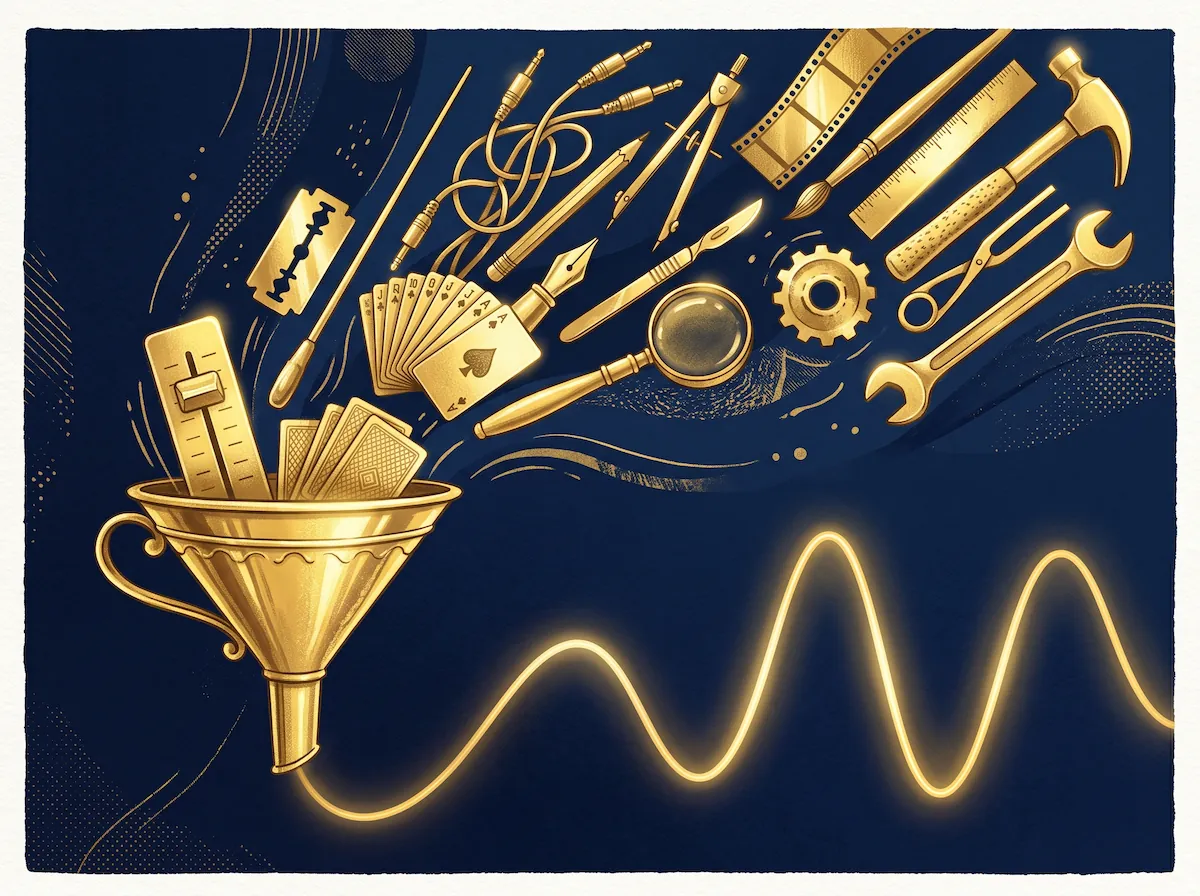
Eighteen figures, three wings, methods that contradict each other completely — and one shared operating system underneath:
| The mindset | How it works in the studio |
|---|---|
| Psychology over technology | A producer is 80% therapist, 20% technician. The best signal chain in the world is useless if the artist is too tense to deliver a great vocal. |
| Ruthless objectivity | Fresh ears on demand, and no preciousness about their own ideas — if an arrangement isn’t serving the song, they kill it immediately, even when it’s theirs. |
| Servant of the song | The production never overshadows the composition. If a track needs a massive hundred-track wall of sound, they build it. If it needs a single raw microphone, they get out of the way. |
| The instrument is whatever exists in your lifetime | Tape, Fairlight, Moog, timeline, model — every wing mastered its era’s machine instead of litigating it. Mastery is what you owe the instrument you were handed. |
Notice, one final time, what appears nowhere in that table: gear, genre, era, or any technology at all. The pantheon disagrees about everything except the hierarchy — song above production, artist above producer, judgment above tools — which is why these philosophies survive every disruption, including the one this magazine covers →. The machines keep changing what’s free. They have never once touched what these eighteen spent their lives mastering.

VI. What the wings disagree about
The universal mindsets are what they share. Equally instructive is where they contradict each other outright — because a producer trying to follow all of this at once will be paralyzed, and the disagreements are where you actually have to choose.
Addition versus subtraction. Quincy Jones → built dynamic tiers, stacking elements section by section into a climax. Rick Rubin → mutes everything not carrying emotional weight and frequently arrives at one voice and one instrument. Both produced canonical records. The resolution isn’t a compromise — it’s diagnosis. Ask whether your song’s problem is that it lacks momentum or that it lacks focus. Addition fixes the first. Subtraction fixes the second. Applying the wrong one makes it worse.
Capture versus construction. Tom Dowd → and the room-recording tradition treat the record as an event that happened; George Martin → and the studio-as-instrument tradition treat it as an object assembled. Flood → destroys sources deliberately; Ghenea → preserves them scrupulously. These are irreconcilable philosophies. The resolution: the choice is not aesthetic preference — it’s about what the record is evidence of. A performance? Or a decision?
Speed versus refinement. Trevor Horn → locks decisions fast, on the argument that over-analysis compresses the energy out of a performance. Dr. Dre → recuts vocals dozens of times and shelves records for years. Both positions are held by people with unimpeachable results. The resolution: the variable isn’t the method — it’s what a given record needs, and, honestly, what a given producer’s temperament can sustain.
System versus accident. Max Martin → treats hit-making as a learnable structural science. Brian Eno → built a deck of cards specifically to break patterns and invite the accident. The resolution: a system without accidents produces competence, and accidents without a system produce nothing you can repeat. Most great records need both, in that order — the system first, so that when the accident happens you can recognize it and keep it.
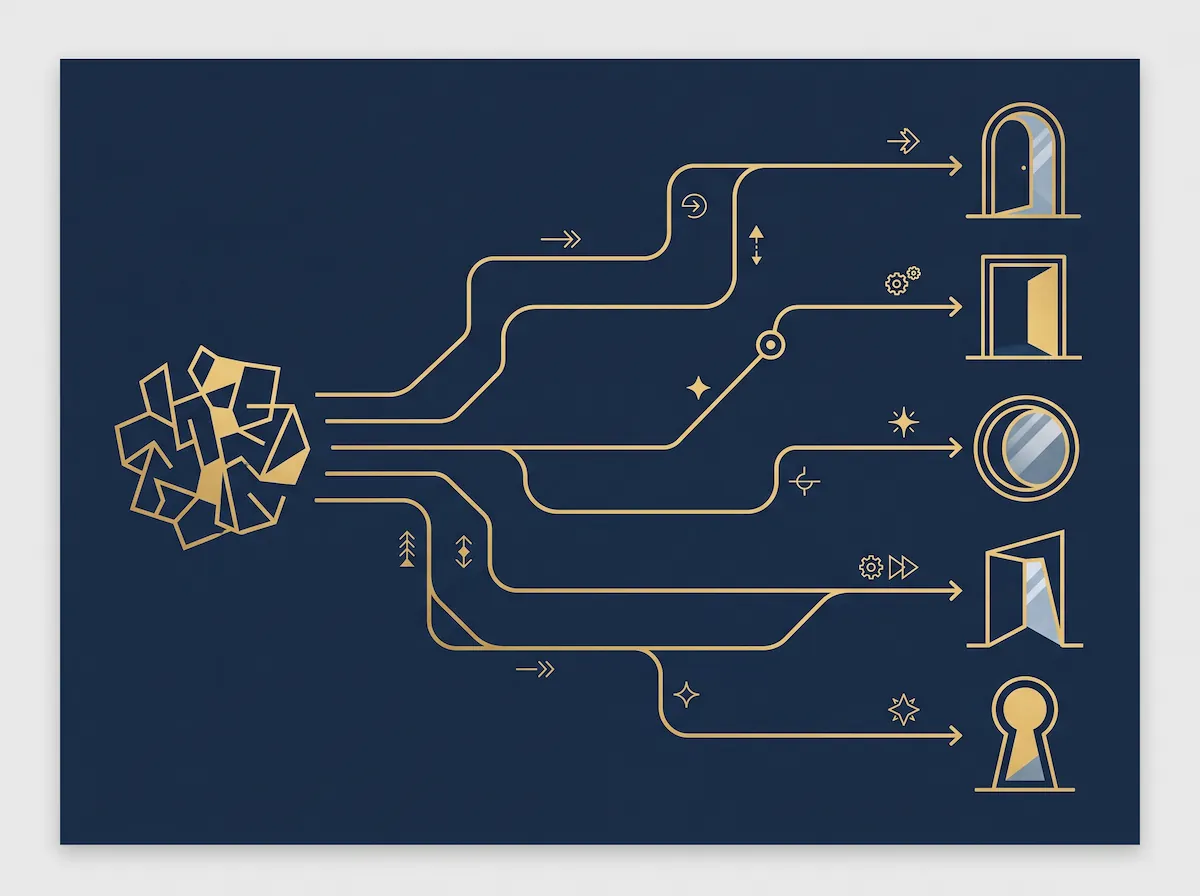
The meta-lesson, and the reason this page is a taxonomy: the pantheon does not agree about method because method is downstream of the problem in front of you. What they agree about is the hierarchy — song, artist, judgment — which is the only thing stable enough to hold across contradictory practices. Treat the wings as a menu of tested approaches, not a set of instructions.
VII. How to use this page
A taxonomy is worthless if it stays a list. Four concrete uses.
1. Diagnose which school your problem belongs to. Stuck on a record? Name the failure honestly — no momentum, no focus, no identity, no energy, no coherence — then go to the wing that solves that specific failure. This page’s real function is a routing table for problems.
2. Steal deliberately from a school you don’t naturally belong to. Your instincts pull you toward one of these approaches; that’s your taste, and it’s also your ceiling. The producer who only ever adds should spend a record subtracting. The one who always chases the accident should try building a system. The fastest growth available to most producers is a season spent working the way they don’t.
3. Use the road stories, not just the methods. Every figure in this Hall arrived sideways: a metal singer →, a nuclear physicist →, a jazz guitarist →, a self-taught programmer →, a man assigned to the comedy division →, a technician who went back to school in her forties →. There is no front door and there never was. That’s not encouragement — it’s the empirical record of how these careers actually started.
4. Read one profile a week and try one thing from it. The Hall exists to be worked through, not admired. A year of that is a genuine education, and it costs nothing but attention.
VIII. The honest counterpoint
1. Any pantheon is an argument, and this one has holes. Eighteen figures cannot represent a century of recorded music across every genre and continent. This list skews Anglo-American, skews toward the commercial mainstream, and — a gap this desk named late and is still correcting — was assembled without a single woman in the original eighteen. That has begun to change in the Masters wing →, and it should be read as a correction rather than as completeness.
2. Canon-making is self-fulfilling. Figures become “legends” partly because publications like this one keep describing them that way, which routes attention to them and away from equally capable people who never got a profile. Every canon does this; naming it doesn’t dissolve it. The best available defense is being explicit that this is a taxonomy of documented approaches, not a verdict on who was best — and continuing to add people who belong.
3. Studying masters can substitute for making things. The failure mode of a page like this is a reader who feels productive while consuming it. Nothing here helps until it’s applied to a session, which is why Section VII exists and why every profile in this Hall ends with something to steal rather than something to admire.
IX. The last thing
The consistent surprise of assembling this Hall was how little the greats agree about technique, and how completely they agree about hierarchy.
They used different tools, in different decades, in different genres, with philosophies that flatly contradict one another. They cannot all be right about method. And yet every one of them, without coordination, arrived at the same three-line ordering: the song outranks the production, the artist outranks the producer, and judgment outranks tools.
That ordering is the actual inheritance. It survived tape, multitrack, digital, the DAW, the loudness war, streaming, and it will survive this decade’s machines — because it was never a statement about equipment. It’s a statement about what music is for.
Everything else in this Hall is a variation. The wings are eighteen ways of honoring one order of operations, and the reason the profiles are worth your time is not that these people were geniuses. It’s that they were people who kept working, in rooms nobody was watching, until the work made the position — and every one of them left instructions.
The instructions are on this page. The rooms are still available.
The Hall of Records grows from this page: The Five Schools → · The Electronic Visionaries → · The Masters: Serban Ghenea → · Tom Dowd → — with every name above queued for its own.