The Hall of Records · The Masters
The Masters: Rick Rubin
He often doesn't touch the board, can't play an instrument at a professional level, and has produced defining records in hip-hop, metal, country, and pop across four decades. The most misunderstood method in the Hall.

The record
Rubin’s discography reads like several different people’s: the founding era of commercial hip-hop with Def Jam (LL Cool J, Beastie Boys, Public Enemy, Run-DMC), then Slayer and Danzig, then the Red Hot Chili Peppers’ imperial run, then the late Johnny Cash recordings that reframed an entire legacy, then System of a Down, Adele, Kanye West, Dixie Chicks, Metallica. Multiple Producer of the Year Grammys. A catalog with no genre center of gravity at all.
The obvious question — what is he actually doing? — has a real answer, and it isn’t mystique.
The method
Subtraction as the primary tool. Rubin’s documented practice is systematic muting: playing back an arrangement and removing anything not actively serving the emotional arc of a section. Not attenuating — removing. The Cash recordings are the extreme demonstration: a voice, a guitar, and nothing to hide behind, which is why they land the way they do.
The stress test. The core diagnostic is performing the song on a single acoustic instrument. If it doesn’t move the room in that form, no production is applied until the writing changes. This is the school’s real value and its most transferable idea: production cannot rescue a song, and treating production as rescue is how months disappear.
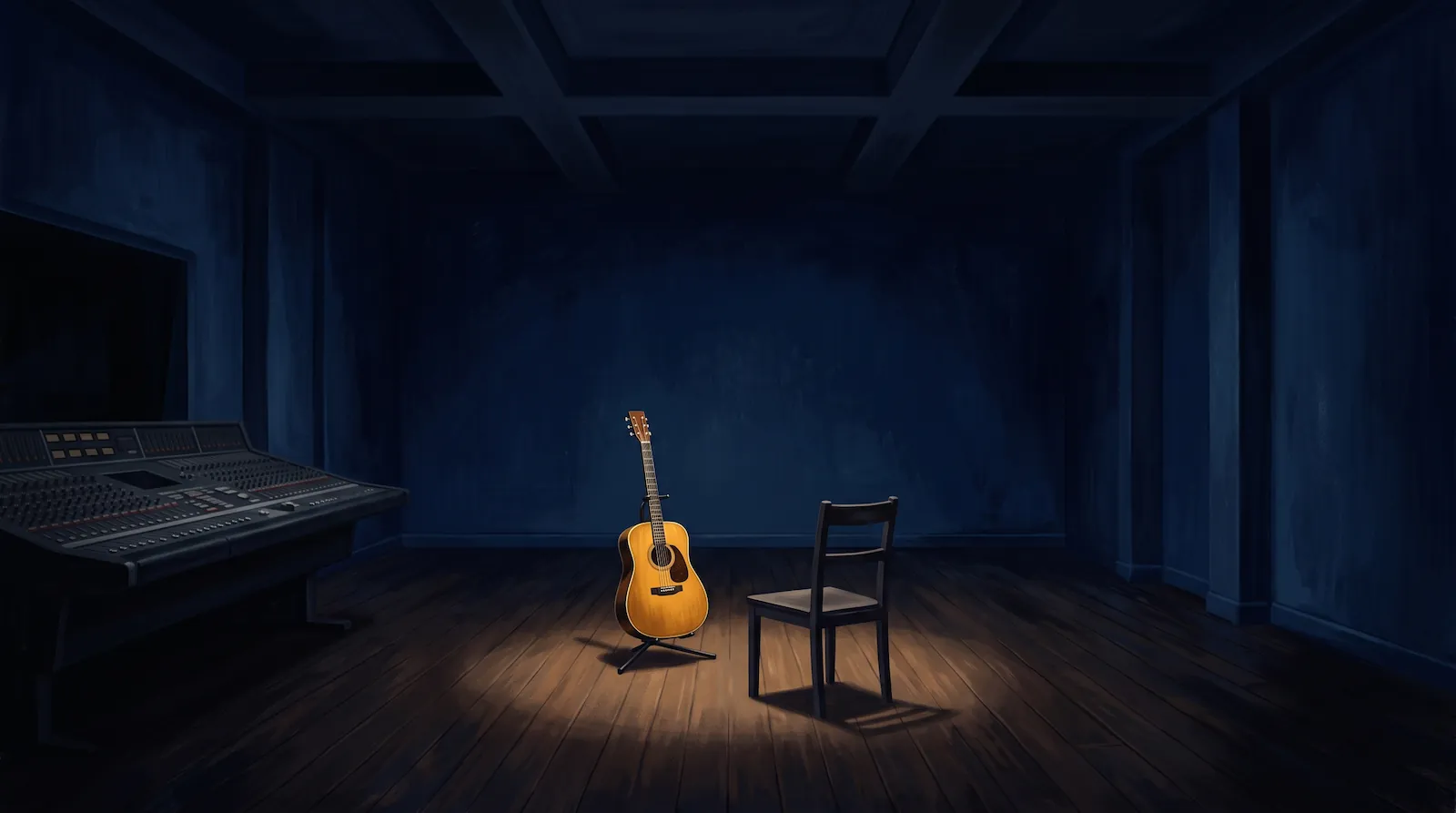
Environment as an instrument. Studios arranged like living rooms; console lights and rack meters removed from view; time pressure deliberately absent — all of it engineered to get an artist into a state where they forget they’re being recorded. A producer in this school is running the psychology, not the signal path. (The Hall’s universal mindset, stated by the Pantheon →, is that a producer is largely therapist and secondarily technician; Rubin is that principle taken to its limit.)
The Rubin production framework
| Production vector | The technical approach | The subtraction method |
|---|---|---|
| Song validation | Stacking production to cover a weak arrangement | The stress test — it must move the room on one voice and one instrument before tracking |
| Arrangement | Adding elements for density and interest | Systematic muting — removing every track that isn’t carrying emotional weight |
| Environment | Meters, clocks, glowing racks, technical tension | Living-room psychology — removing distraction to induce flow |
| Primary value | Signal chain and engineering execution | Taste and judgment — deciding what’s true, what’s false, and when it’s done |
What a working producer should steal, immediately: the stress test costs nothing and will save you more time than any workflow change available. Before you produce anything, play it stripped — one voice, one instrument, no processing — for someone whose taste you trust and whose approval you don’t need. What survives that room is what deserves your months.
The road
Long Island; a teenager with a guitar and a punk band; then NYU, where he ran Def Jam out of his dorm room with Russell Simmons — arguably the most consequential dorm-room company in music history. He produced hip-hop before the industry believed it was a business, moved to Los Angeles, founded Def American, and then made a career-defining choice that this desk should notice: he kept working with artists everyone else considered finished.
Johnny Cash in the early ’90s was label-less and commercially written off. Rubin signed him and produced American Recordings — one voice, one guitar — and the results reframed how the culture understood the man. That is the subtraction method as a career strategy, not just a mixing preference: strip a great artist to the thing that was always great about them.
For producers reading this in the AI era, Rubin’s road carries an odd, specific reassurance. He is the least technical figure in the entire Hall — no engineering pedigree, no instrumental virtuosity, no signature processing chain — and none of it mattered, because his actual product was judgment. Judgment is precisely the layer machines have not commoditized, and the man who built four decades on it without touching a fader is the standing proof that the layer is real.
The honest counterpoint
The Rubin school is the easiest in the Hall to cosplay, and the cosplay is worthless. “I don’t touch the board” is a method when it’s paired with taste developed across thousands of records and the nerve to tell an icon their song isn’t ready; it’s an excuse when it isn’t. The subtraction school also has real critics: engineers who’ve noted that someone in the room still has to actually make the record, and artists for whom minimalism was the wrong prescription. Both are fair. Take the stress test and the muting discipline; don’t take the persona.
Currently
2026-04 — Named a Musical Excellence honoree in the Rock & Roll Hall of Fame’s Class of 2026, alongside Linda Creed, Arif Mardin, and Jimmy Miller. The induction ceremony takes place November 14 at the Peacock Theater in Los Angeles; the class’s performer inductees include Phil Collins, Billy Idol, Iron Maiden, Joy Division/New Order, Oasis, Sade, Luther Vandross, and Wu-Tang Clan.
The Hall of Records: The Pantheon → · The Five Schools → · The Masters: Serban Ghenea →