The Great Bifurcation: Why the Music Economy Is Splitting in Two
The music economy is actively splitting into Ghosts and Architects — and the platforms just said so out loud. Pick a side, because the middle ground is closing fast.

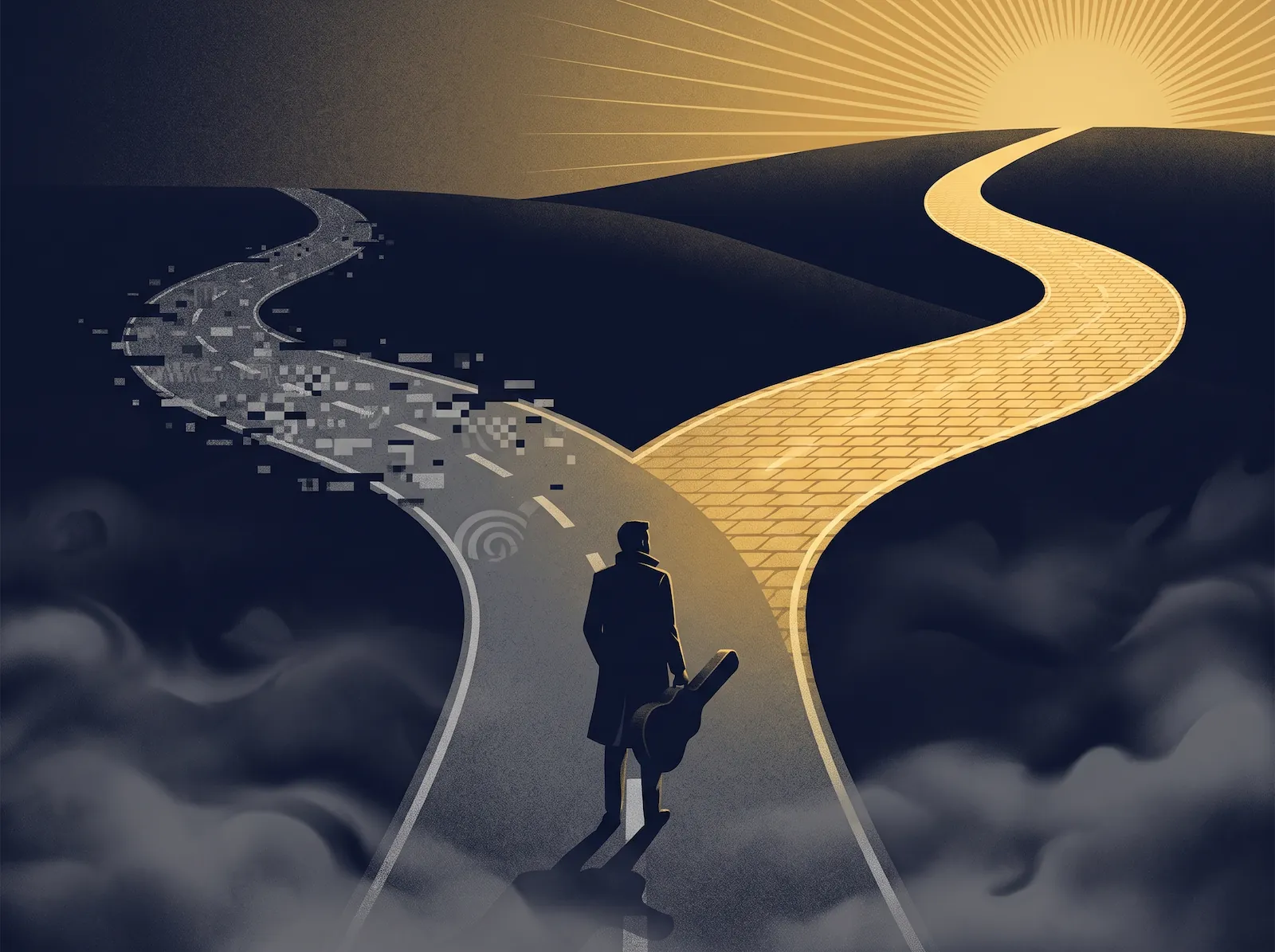
Every technological disruption in music history eventually forces a reckoning — a singular moment where the market stops debating the new tool and starts pricing the difference between the professionals who wield it and the people it replaces. Recording had its moment. Sampling had its moment. This month, the AI era had its own: the CEO of the world’s largest AI music generator announced that his platform will durably watermark and fingerprint everything it creates, partnering with major distributors to enforce the line between meaningful human creation and mass synthetic export.
Read that announcement for exactly what it is. The company that industrialized generative music just declared that undifferentiated AI generation is not the product. The platform itself is drawing a hard line between its power users and its flood. When the flood’s own manufacturer starts marking the water, The Great Bifurcation is no longer a thesis. It is industry policy.
The music economy has permanently split into two diverging asset classes.
On one side: The Ghosts. Creators whose output is indistinguishable from the machine — and now, cryptographically identified with it. They operate with infinite supply, near-zero marginal cost, and no registrable ownership, while an algorithmic enforcement apparatus tightens around them.
On the other side: The Architects. Producers who direct the machine but fully author the result. Their catalogs are human-performed, legally owned, meticulously documented, and — by the sheer exclusion logic of every watermark deployed — certified by the exact same systems built to purge the Ghosts.
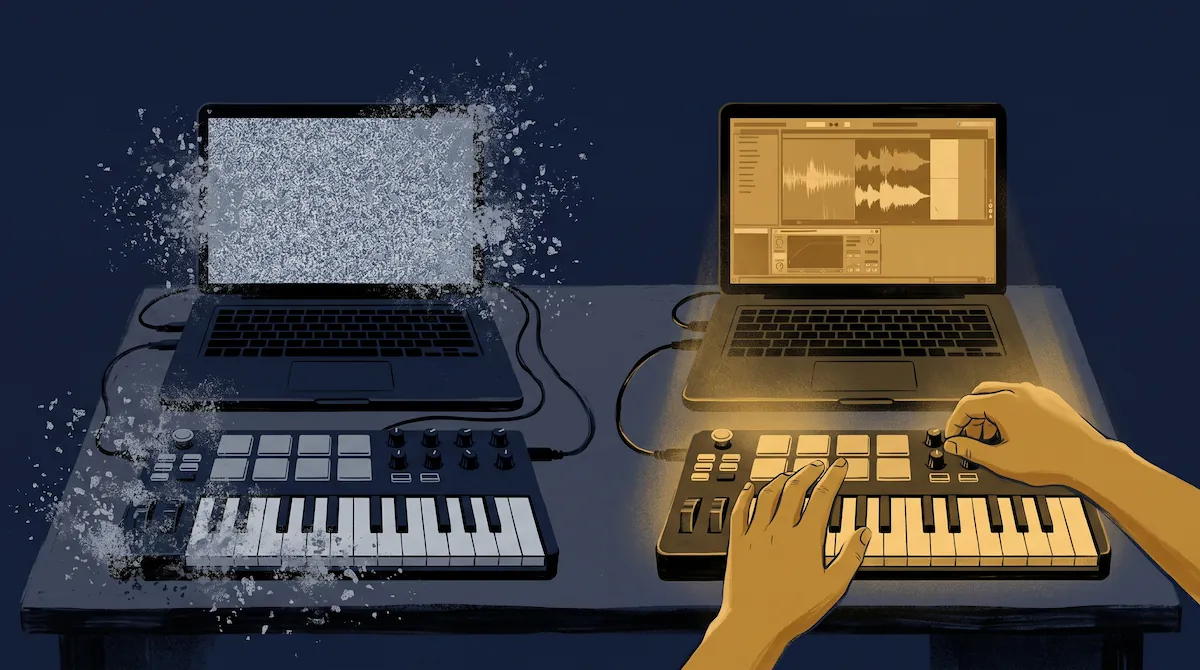
The cruel elegance of this moment is that both classes are using the exact same tools. The bifurcation isn’t about access to AI; everyone has access. It is entirely about what audio survives into the final deliverable, and who can prove it. Two producers can spend the same afternoon with the same generator and walk out holding two entirely different asset classes: one holds watermarked, un-ownable inventory, while the other holds a structural sketch they are about to re-perform into property.
The tool didn’t make the decision. The workflow did.
The middle was never stable
I watched the bifurcation happen in my own phone. My friends outside music: excited about Suno, playing with it, sharing songs. My friends inside the industry — decades of credits, all the awards — mostly complaining that it was disrespecting their work. Both groups were right, and neither realized they were describing the same event from opposite shores. And the professionals quietly experimenting in between — myself included — were being sorted by our workflows before any of us knew a sorting was underway.
The most tempting position in the industry right now is the middle — leaving a little generated audio in the master, maintaining a little ambiguity in the chain-of-title paperwork, and trying to ride both economies at once.
The new infrastructure has explicitly said no. Cryptographic fingerprinting does not average out. Distributor AI-disclosure fields do not accept “mostly human” as an answer. Every ingestion scanner deployed this year makes the middle ground exponentially more expensive to stand on, because algorithmic ambiguity now defaults to penalizing the undocumented. The true casualty of The Great Bifurcation isn’t the honest Ghost; it is the almost-Architect who failed to keep their receipts.
Choosing is free today — and expensive tomorrow
Here is the operational asymmetry that should dictate your next twelve months: crossing the line to become an Architect costs almost nothing today. It requires a re-performance discipline, a documentation habit, and a workflow ruling. But that discipline compounds into everything later: unrestricted distribution, a fully registrable copyright catalog, sync licensing eligibility, and a premium valuation that rises every time the platforms tighten enforcement on the Ghosts.
Waiting reverses the math. Catalogs built in the ambiguous middle cannot be converted retroactively. If the sessions weren’t documented and the stems weren’t logged, the proof simply does not exist. You cannot back-date audio provenance.
The distribution platforms have chosen their architecture. The major labels have chosen their strategy. The regulators have chosen their timeline. The only actor in this bifurcation still enjoying a free choice is the independent producer — and the window on “free” is closing.
Ghosts inherit the flood. Architects inherit the market. Same tools, one decision.