The Songwriter's Mixing Primer
Mixing is not a technical discipline you are missing — it is the last verse of the arrangement, written with faders. The uncompromising primer for people who think in songs, not signal chains.

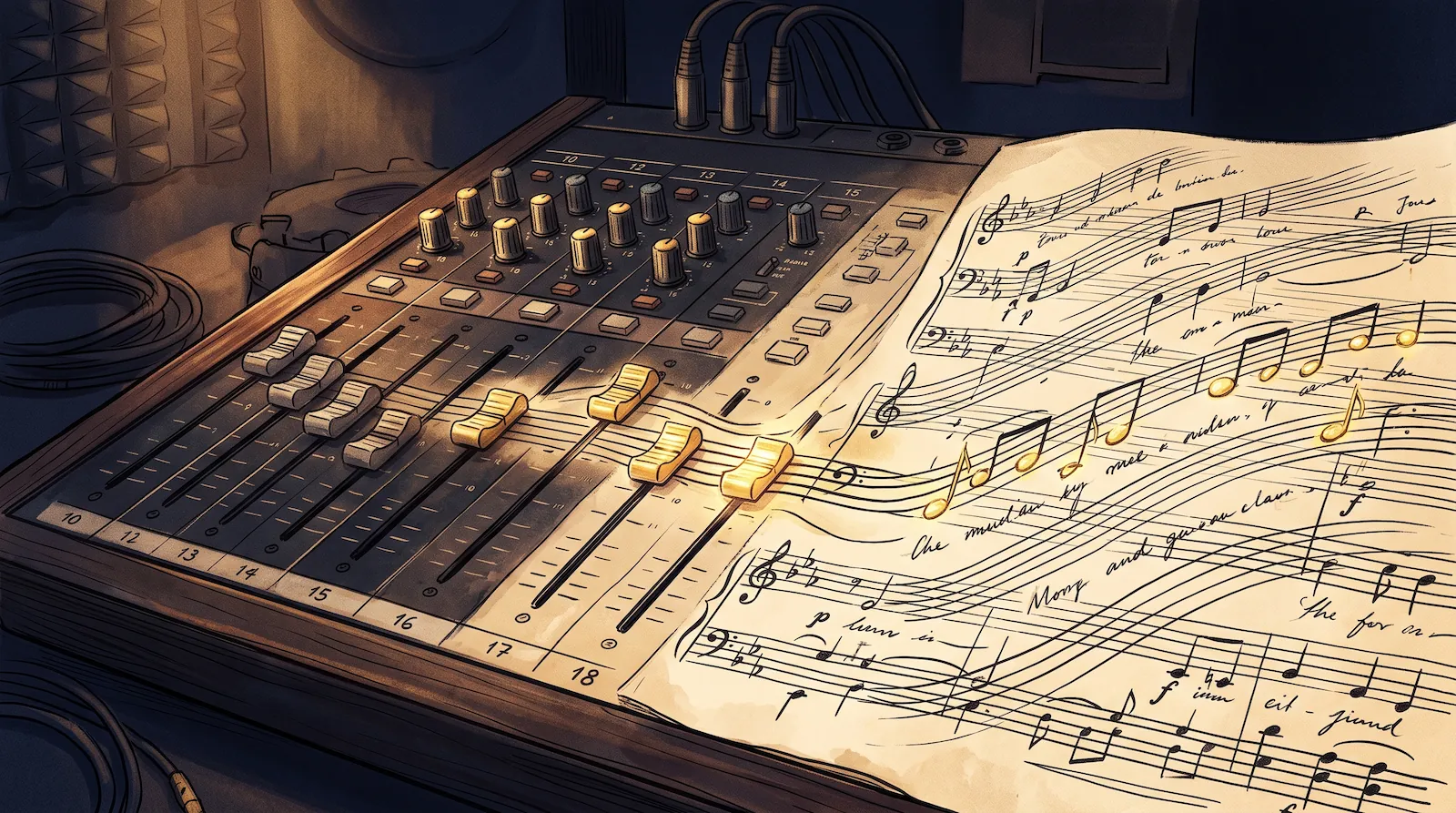
Here is the reframe that makes mixing entirely learnable for a songwriter, and it is the one the engineering world rarely offers you: mixing is arrangement, continued.
Every single mix decision you make — what is loud, what is pushed forward, what is ruthlessly carved away — is a song decision. You are deciding which melodic line the listener follows, exactly where their attention lands in the chorus, and what emotional weight the bridge is actively withholding. You have made these exact decisions your entire writing life. The faders are just the place where they get finalized. Whatever DAW you push them in, you are not entering a foreign discipline. You are finishing the sentences you started on the page.
With that frame firmly set, the primer reduces to five non-negotiable habits.
The five habits of the songwriter-mixer
1. Balance before everything. The most unglamorous secret of professional mixing: static balance — just the faders and the pan pots, with zero processing — determines the vast majority of the outcome. Before you touch a single plugin, spend real time making the raw tracks sit right: vocal on top, groove locked underneath, everything audible, nothing fighting. A world-class balance with zero plugins will always beat a poor balance with fifty boutique emulations. Most amateur mixes fail right here, at the cheapest possible stage to succeed.
2. Mix from the vocal outward. For a songwriter’s music, the voice carrying the lyrics is the gravitational center of the mix. Set it first, then arrange everything else around it in the exact sense you already understand: supporting parts support, answering parts answer, nothing competes with the line that actually matters. When an element fights the lead vocal, the mix question is really an arrangement question: does this part need to be quieter, darker, moved to the side — or completely muted?
3. Learn the grammar, not the plugins. Every processor belongs to one of eight families answering eight questions →, and a song-thinker only needs the big three fluently: EQ (which frequencies — space-making), dynamics (how loud, moment to moment — control), and time-based (how big a room — depth). Chains read in strict grammatical order — subtract, control, color, place — the same syntax as your vocal chain →, applied instrument by instrument. Everything else is vocabulary you can acquire as your songs demand it.
4. Reference like a professional — because you cannot trust yourself yet. The self-mixing bias → applies doubly to the person who also wrote the song: you will subconsciously hear what you meant, not what is coming out of the speakers. The defenses are entirely mechanical: commercial references in the session from minute one, rigorous level-matched comparisons, and final verdicts rendered on the honest translation systems — the iPhone speaker, the car test, the cheap earbuds, the next-morning cold listen.
5. Know what “done” sounds like. A songwriter’s mix is done when it meets from Demo to Pitch-Ready →: it plays immediately after a commercial reference at matched volume without asking for the listener’s imagination; the vocal is always intelligible; it translates across four playback systems. And — the ultimate writer’s test, the one no engineer can ever run for you — the song still means exactly what you meant. Past that point, you are no longer mixing. You are just avoiding writing the next song.
The honest scope note
Because this masthead deals in disclosed costs, understand the scope: these five habits make you fully capable of pitch-ready and release-ready mixes of your own material — the self-sufficiency the IP Matrix’s ownership ladder →. Will your flagship records still deserve a specialist’s elevation? Absolutely. But by the time you are hiring an elite mix engineer, you will actually possess the vocabulary to hear what you are buying — and that changes the entire relationship from helpless dependence into high-level direction.
That is the actual endgame of the Second Craft: not doing everything yourself forever, but never again being unable to →.