The Songwriter's First Vocal Chain
You already know more about vocals than most engineers ever will — phrasing, breath, the emotional center of a take. What's missing is the chain that gets it onto tape competitively. Here it is, in your language.

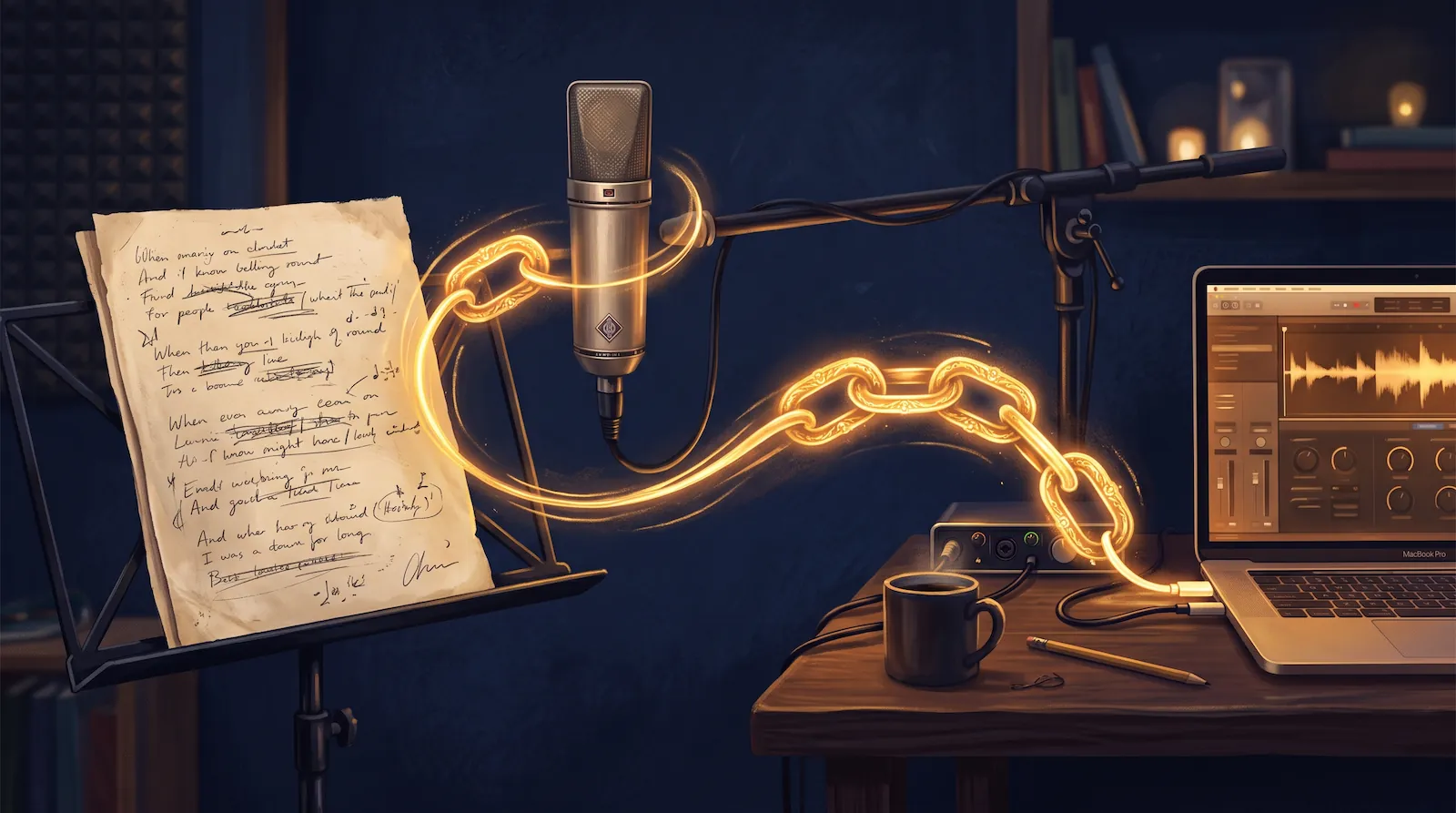
Start with what Why Hitmakers Are Learning to Produce → established: the smart money in the songwriting profession is learning production vocal-first. The vocal is exactly where a pitch lives or dies. It is the craft closest to what a writer already inherently masters, and it is the single most expensive thing to keep outsourcing. This is the entry door, forced open.
One reframe before you buy any gear: you are not starting from zero. A professional songwriter hears phrasing, pitch, breath, and emotional truth at an elite level — and that is the hard half of vocal production. The engineer’s half — the capture and the processing — is a learnable, finite system. You are not becoming an entirely different professional. You are adding technical hands to the elite ears you already own.
Part one: the capture
The room beats the mic. Before you make a single purchase: record away from bare parallel walls, surround the mic position with soft, irregular surfaces (a dense closet of hanging clothes is a completely legitimate vocal booth), and ruthlessly kill the ambient noise sources you’ve stopped noticing. An honest dynamic mic in a treated corner will beat a luxury tube condenser in an untreated bathroom, every single time.
One good chain, learned. A single quality microphone into a clean interface is your entire capture system — and the documented history of this era’s biggest bedroom records → proves the ceiling sits far above the price tag. For a concrete starting point, our published house standard — [the Sovereign Studio Standard →] — runs a Sennheiser e935 into a used Apogee Duet 2: professional, affordable, and chosen for the signal path rather than the spec sheet; the full reasoning lives in the Gear Spec. Whatever chain you choose, set your input gain so your absolute loudest phrase never clips, with honest headroom below it. That is the entire science of gain staging for a vocal: room to be loud, silence underneath.
Perform in takes, not in verdicts. Record full, continuous passes — three to five — before judging absolutely anything. The songwriter’s instinct to stop and fix a line mid-take is the very first habit the second craft retires. Takes are raw material. The judgment happens afterward, in the comp.

Part two: the comp and the tune
The comp. Comping is the surgical assembly of the master take from the best moments of all your passes — phrase by phrase, sometimes word by word. This is where your writer’s ear becomes an unfair superpower: you already know exactly which delivery of the line actually means it. Choose for emotional truth first, technical cleanliness second. The chain below fixes tone; absolutely nothing downstream can fix a take that lacks conviction.
The tune. Tuning comes only after comping, and the doctrine is one sentence: tune the notes; keep the performance. Correct the pitches that distract the listener, but leave the scoops, the falls, and the human motion that carry the exact phrasing you wrote. Transparent correction on a great comp is completely invisible. Heavy correction standing in for a weak comp is the exact synthetic artifact every listener has been trained to hate.
Part three: the chain
The processing chain runs in strict grammatical order →. For a modern lead vocal it always reads — subtract, control, color, place:
- Subtractive EQ. Remove exactly what the room and the mic accidentally added: high-pass the rumble out below the voice’s range (80–100 Hz is a working starting point), and carve out any boxy buildup before you boost anything.
- Compression (control). Even the dynamics so every word stays present and locked in the pocket. Aim for the compressor working steadily but gently; if you can hear it audibly grabbing the transients, relax it.
- Gentle color. A slight touch of saturation for density and an expensive harmonic footprint — the exact difference between a vocal sitting awkwardly on the track versus glued in it.
- Space (place). A short delay or modest reverb, mixed noticeably lower than your initial instinct suggests — placing the voice in a room without washing out the exact words you just wrote.

The finish line for this piece of the craft is completely concrete: a comped, tuned, chained vocal of your own song that sits confidently against a commercial reference at matched volume. When yours holds that comparison, the entry craft is officially yours — and everything after it (From Demo to Pitch-Ready →, The Songwriter’s Mixing Primer →, The Learning Order →) builds precisely on the skills this page just installed.
Performance over plugins — signed
(From Deyder’s dictation, Aug 10.)
Here’s my version of performance-over-plugins. When we talk about EQ, most people reach for the knobs first — physical or digital. I say reach for the right pick material. Do a sound bath before the take — listen while doing a little breathwork, so you relax and play softer. Take a sip of warm tea with honey to smooth out your voice right before singing. Immediately, the physical world has performed the first EQ — the instrument itself, doing the shaping before any signal exists to process.
With digital sources — synths recorded via MIDI — it’s different but the approach is the same: choosing the right sound is the beginning of mixing, while you’re still producing, and it’s why the mix stage becomes seamless when you’ve chosen well. And when I choose sounds, I listen for colors — juxtaposition, contrast, complementary flavors. If something feels like vanilla, I add chocolate, pistachio, mint — I don’t just throw more vanilla at it; I don’t mix chocolate with more chocolate. I’ll describe sounds like ice cream, or I’ll call them abrasive, sparkling, woolly, warm, round — whatever words carry the vibe — so that everything coming into the mix is coming together cohesively, on purpose, from the first choice.
— D.C.