Types of Audio Effects: The Producer's Full Taxonomy
Every processor in every plugin folder belongs to one of exactly eight families. Learn the families and no interface will ever confuse you again — the reference page for the entire desk.

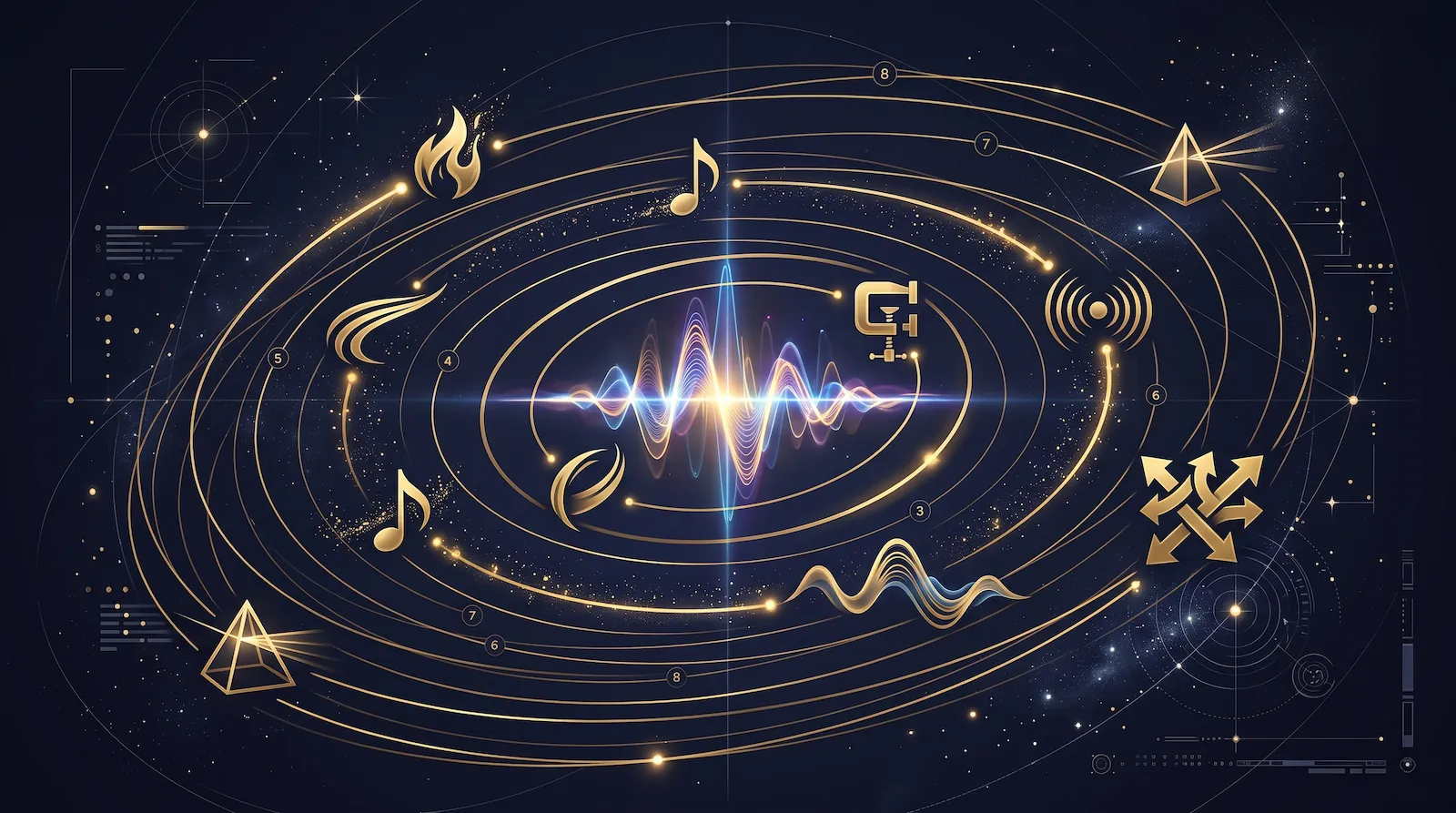
Audio effects are processors that alter a recorded or synthesized signal after its creation — shaping its dynamics, its frequency content, its position in time and space, its pitch, its harmonic character, or its stereo placement. Every single effect a producer will ever touch, regardless of brand name, price tag, or vintage interface, belongs to one of eight functional families, and each family answers exactly one question about the sound.
This page is the map. The rest of this desk builds directly on top of it.
The eight families
| Family | The question it answers | Core members | The producer’s shorthand |
|---|---|---|---|
| Dynamics | How loud, moment to moment? | Compressor, limiter, gate, expander, transient shaper | Control and punch |
| EQ & filters | Which frequencies, and how much? | Parametric EQ, shelving EQ, dynamic EQ, high/low-pass filters | Tone and space-making |
| Time-based | Where is the sound, and how big is the room? | Reverb, delay/echo | Space and depth |
| Modulation | Is it moving? | Chorus, flanger, phaser, tremolo, vibrato, rotary | Motion and width |
| Pitch | Which notes, exactly? | Pitch correction, pitch shifting, harmonizers, formant tools | Tuning and harmony |
| Distortion & saturation | How much harmonic character? | Saturation, overdrive, distortion, bitcrushing, tape/console emulation | Color and density |
| Spatial & imaging | Where in the stereo (or 3D) field? | Panning, stereo wideners, mid/side tools, spatializers | Placement and width |
| Spectral & resynthesis | Can we rebuild the sound itself? | Vocoders, spectral filters/freeze, granular processors, convolution beyond reverb | Transformation |
How to read the taxonomy like an Architect
Every plugin on the market is a family member wearing different clothes. The audio software market ships thousands of individual products; it has shipped very few actual ideas. A $300 boutique compressor and your DAW’s native stock compressor are the exact same family answering the exact same question — the boutique unit differs in character, knee shape, and workflow, not in kind. Producers who learn these families can walk up to any interface ever made and know exactly what it does before reading the manual. This is the literacy the free-tools verdict → assumes, and exactly how the mastering chain → organizes its seats.
Chains are sentences; families are the grammar. A professional vocal chain reads: EQ (subtract) → dynamics (control) → pitch (tune) → saturation (color) → time-based (place). The order is the syntax, and most signal-chain problems are grammar problems — color before control, space before subtraction. Learn the grammar once, and every genre’s chains become local dialects, not new languages.
Three families do ninety percent of the work. Dynamics, EQ, and time-based effects carry nearly every hit record ever made; the other five are seasoning, transformation, and pure style. Budget your learning exactly like the work is distributed: deep, unshakeable fluency in the big three, working knowledge of the rest — the same allocation logic as the five mastering seats →.
And one modern note the taxonomy clarifies: the AI-era tools flooding into your plugin folder — stem separators, spectral repair, generative processors — are largely family members too (mostly spectral & resynthesis), and the same producer’s questions apply to them: what does it answer, what does it cost the signal, and — per house doctrine — what survives into the final master? →
Eight families, eight questions, one map. Everything else on this desk is furniture arranged inside it.
The Sound Desk: The Palette verdicts → · The Rig, documented → · the braams-and-pads recipes →