The Hall of Records · The Schools
The Schools: The Scoring Legends
The third wing of the pantheon writes for picture — five composers whose philosophies solved a problem pop never faces: music that must serve a story it doesn't control.

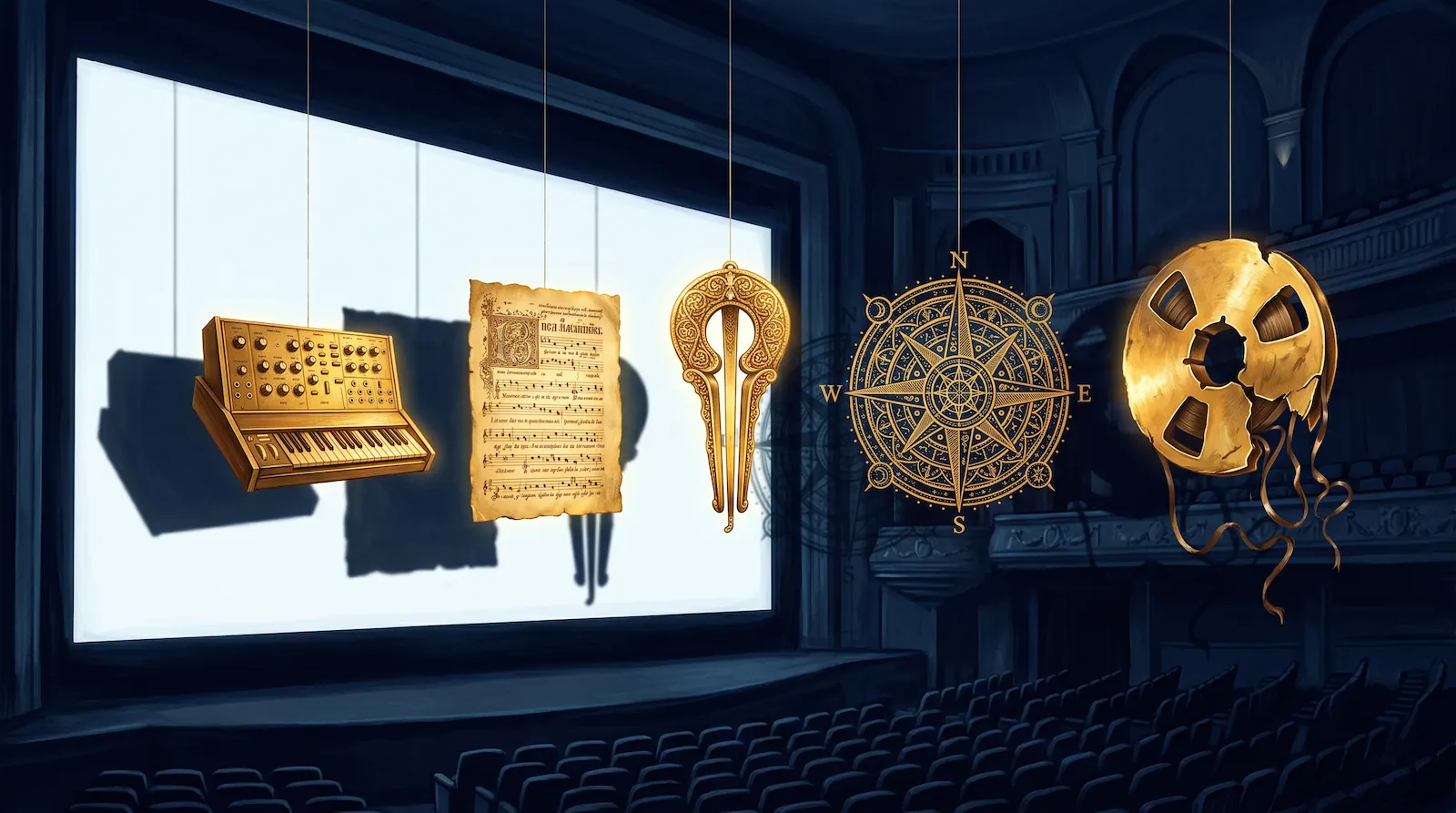
The Five Schools → mapped the record-makers; The Electronic Visionaries → mapped the machines. The third wing writes under a constraint neither faces: the music is not the point. A score exists to serve a story it doesn’t control, at lengths it doesn’t choose, under dialogue it must not fight — and the five philosophies below are five complete answers to that problem. Which makes this the wing that transfers most directly to producers who will never score a film, because every one of them solved working inside someone else’s constraints without disappearing. That’s the sync brief. That’s the artist session. That’s most professional work there is.
The Hybrid Architect — Hans Zimmer
The philosophy: build the world first. Zimmer erased the boundary between electronic sound design and symphonic orchestration — and his defining method is sequence: rather than scoring directly to early picture cuts (where every re-edit forces rewritten measure lengths and destroys musical phrasing), he composes long standalone thematic suites from script discussions and concept art — the film’s entire musical DNA explored before a frame is locked. Underneath sit bespoke sample libraries recorded for that film alone, and above sit vast stem systems that let music editors conform the score to new cuts without re-orchestrating anything. The lesson: build the sonic world first; every cue is just a visit to it. For a producer, the translation is exact — design your palette before you chase the deadline →, and revisions stop being rewrites.
The Symphonic Master — John Williams
The philosophy: theme is structure. Pencil, manuscript paper, and piano — Williams composes the counterpoint and voice-leading first, on their own musical merit, entirely independent of any studio process. His engine is the Wagnerian leitmotif: distinct, recognizable themes assigned to characters and ideas, then transposed, inverted, and contrapuntally woven as the narrative turns, so the score tells the story structurally rather than merely accompanying it. The lesson: a melody you can whistle is engineering, not accident — and material strong enough to survive a piano sketch is material that survives any production decision you make later.
The Timbral Maverick — Ennio Morricone
The philosophy: one unforgettable sound beats forty correct ones. Morricone elevated non-traditional timbres — whistling, electric guitars, jaw harps, soprano improvisations — to the primary thematic voice over conventional orchestral leads, and built his scores around wide spatial gaps and sudden silence rather than continuous accompaniment. The lesson: silence is a section of the orchestra, and the identity of a piece usually lives in its strangest choice, not its most correct one. Every producer who has ever buried the interesting sound under three safe ones is fighting the Morricone lesson.
The World-Builder — Howard Shore
The philosophy: coherence at scale. Shore treats scoring as operatic history — a vast network of interconnected motifs mapped not only to characters but to cultures, geographies, and moral shifts, with instrumentation matched to lore, so a character’s theme gradually adopts the harmonic color of the region they enter. The lesson: systems thinking is an artistic instrument. Audiences can’t name coherence at that scale, but they feel it — the same reason an album with a real sonic logic outperforms a folder of good songs.
The Subtractive Atmosphericists — Trent Reznor & Atticus Ross
The philosophy: what you withhold does the work. They redefined the modern thriller score by stripping away orchestral bombast entirely: altered tape loops, bit-crushed pianos, acoustic sources degraded through amplifiers and broken machines, and micro-tonal drones sitting barely above the threshold of hearing — psychological tension engineered underneath dialogue rather than over it. The lesson: restraint is not the absence of a choice; it is the loudest one available — and the frequency space you refuse to occupy is what lets the important thing land.
The wing’s shared law
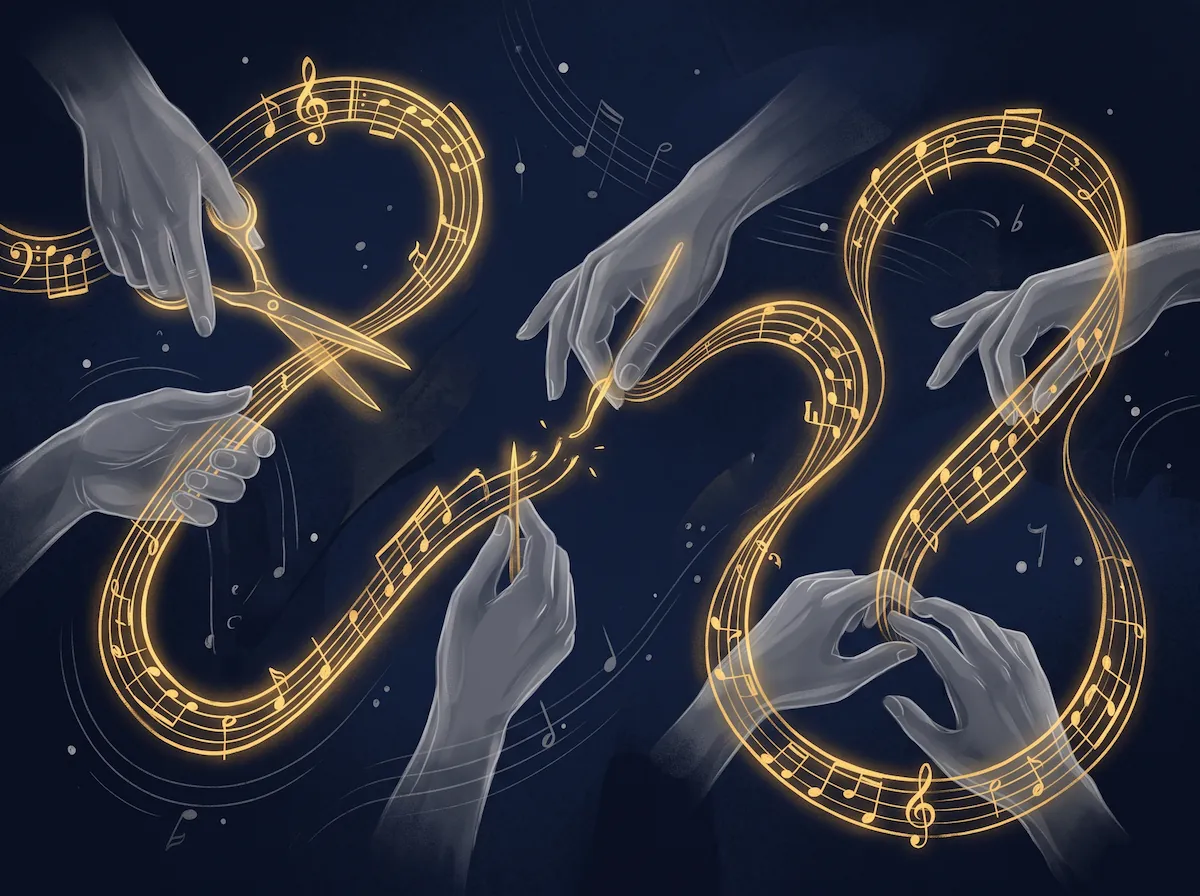
Run the five against the universal mindsets → and the pantheon’s operating system holds — but scoring adds a clause pop rarely states: the work must survive being changed by someone else. Re-edits, dialogue, direction, a producer’s notes at 2 a.m. Zimmer’s stems, Williams’s piano-proof themes, Shore’s systems, Morricone’s identifiable timbres, Reznor and Ross’s withheld space — all five are architectures for surviving other people’s decisions with your authorship intact. Which is, quietly, the same problem this masthead’s entire doctrine → solves at the ownership layer. The scoring wing just got there first, in a different room.
The Hall of Records: The Pantheon → · The Five Schools → · The Electronic Visionaries → · The Masters: Serban Ghenea → · Tom Dowd →