The Hall of Records · The Masters
The Masters: Butch Vig
He made the loudest album of a generation sound like a pop record — deliberately. The drummer-engineer who built his own studio in Wisconsin, then produced *Nevermind*, *Siamese Dream*, and *Gish* from outside every industry center.

The record
Nevermind. That would be enough, but it isn’t the half of it: Smashing Pumpkins’ Gish and Siamese Dream, Sonic Youth’s Dirty, Foo Fighters’ Wasting Light, Green Day’s 21st Century Breakdown, AFI, Against Me!, plus a second career as drummer and co-producer in Garbage — a band that sold tens of millions of records while its producer-members treated the studio as the primary instrument.
The through-line: Vig is the producer who brought pop construction discipline into music that was ideologically opposed to it, and made the combination sound inevitable.
The method
Pop craft inside heavy music. The most misunderstood fact about Nevermind is that its power comes from arrangement and clarity, not volume. Vig’s documented practice — double-tracked vocals, layered guitars, meticulous comping, choruses arranged to arrive — is straight-ahead pop record-making applied to material that arrived as raw punk energy. The band’s ferocity was never diluted; it was staged so a listener could hear every part of it.
Double-tracking as a defining texture. Vocals and guitars recorded twice and layered, producing the thickness and slight chorusing that defines the era’s sound. Simple, old, and enormously effective — and the technique most immediately available to anyone reading this.
Drums first, and drums right. A drummer’s ear runs the whole method: the kit is the record’s foundation, tuned, mic’d, and placed in a real room, and everything else is built to fit what the drums are already doing. The Vig school’s records feel large because the drums are large before processing.
Serve the song’s intent, not the genre’s rules. Vig’s approach to material is functional: what does this song need to land? If the answer is a clean vocal double, a slower tempo, a rewritten pre-chorus, the answer isn’t rejected for being insufficiently underground.
The Vig production framework
| Production vector | The underground ethos | The Vig method |
|---|---|---|
| Energy capture | Volume and raw untamed performance | Pop architecture — staging ferocity through clarity and arrangement |
| Texture | Over-distorting one heavy guitar track | Double-tracking — layering distinct performances for natural thickness |
| Foundation | Mixing drums to fit the guitars | Drums first — a large kit in a real room, everything built around it |
| Creative choices | Rejecting polish to protect genre authenticity | Serving the song — the right emotional choice, even when it’s a pop technique |
What a working producer should steal: double-tracking, tonight. Record the part twice, pan the two takes hard left and hard right, and hear the difference — it costs nothing and teaches more about thickness than any plugin. And structurally: make the chorus arrive. Vig’s records are built so that the loud moment lands because something quieter preceded it, which is arrangement doing work that no mastering chain can supply.
The road
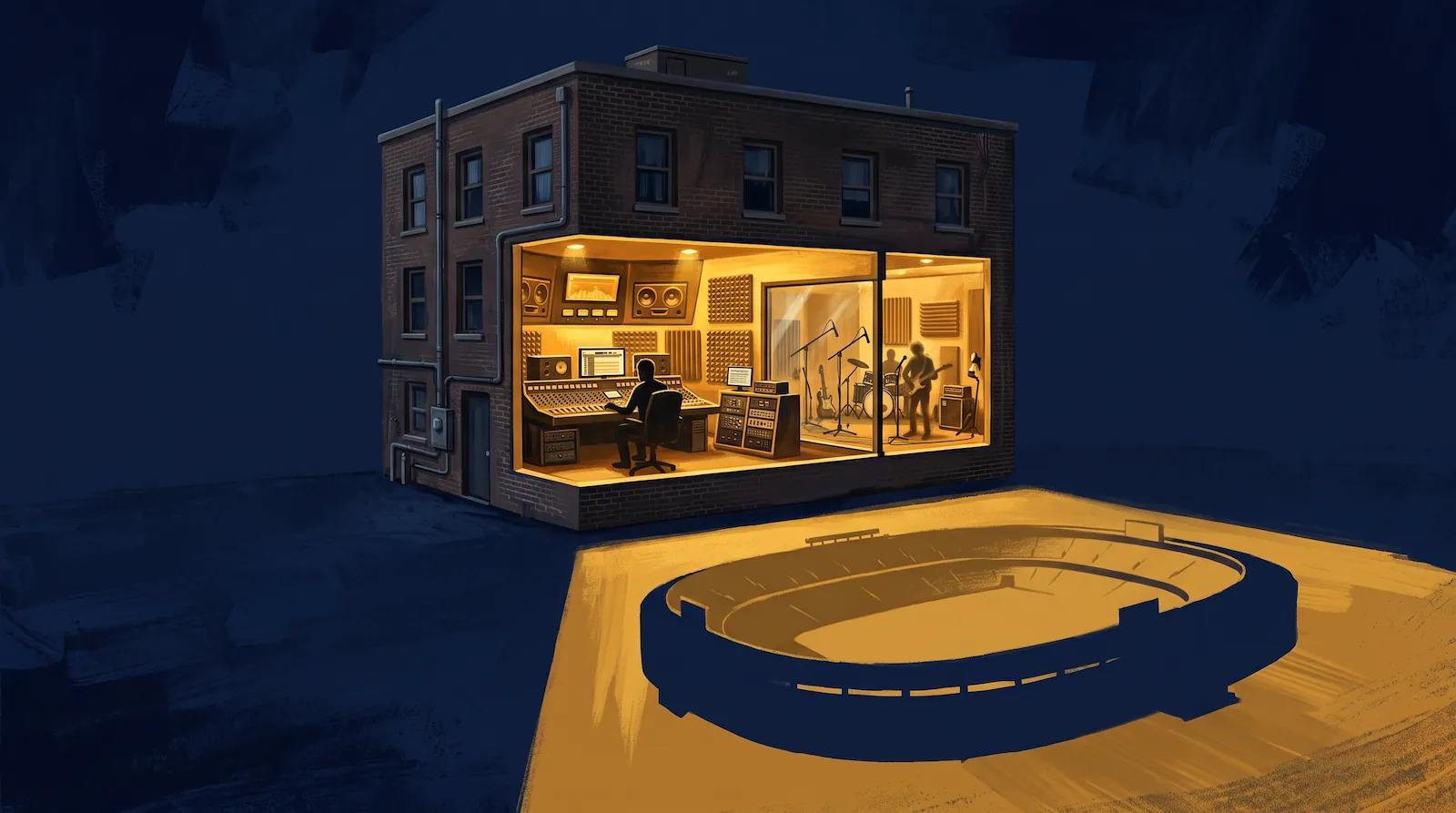
Viroqua, Wisconsin, then Madison — where Vig and Steve Marker built Smart Studios essentially themselves: a low-cost room in a midwestern city, funded by recording local punk and alternative bands cheaply, hundreds of records deep in obscurity through the 1980s. He wasn’t waiting to be discovered by an A&R rep; he was running a business and getting extremely good at making records fast on limited budgets.
Then Sub Pop sent him a band from Seattle.
Read that road carefully, because it’s the most directly applicable in the Hall for anyone reading this from a bedroom or a spare room: the studio that made Nevermind was built by the guy who produced it, in a city with no music industry, financed by unglamorous local work. No apprenticeship at a famous room, no relocation to a capital, no permission. Volume of records, a room of his own, and a hundred small jobs that taught him to work fast — and when the once-in-a-generation session arrived, he’d already made every mistake it required him not to make.
The second act says something too: rather than settling into producer-for-hire status after the biggest record of the era, he started a band and became an artist on his own catalog. The Hall’s recurring lesson, in another key — the people who last build a position, not just a reputation.
Currently
2026-05 — Reunited in the studio with The Smashing Pumpkins — Billy Corgan, James Iha, and Jimmy Chamberlin — recording a new single, their first work together since the Siamese Dream sessions 32 years earlier. Corgan announced it on May 19; the song is finished and slated for release later this year.
2025–2026 — Released Garbage’s eighth album, Let All That We Imagine Be the Light, followed by international touring.
2026 — Served as musical director for the Joey’s Song benefit concert in Madison, Wisconsin.
The Hall of Records: The Pantheon → · The Masters: Flood → · Rick Rubin → · Tom Dowd →