The Solo-Unicorn: From Laborer to Conductor
The Blueprint projected a new class of music entrepreneur: one person, an AI stack where the entourage used to be, and value flowing to vision instead of hours. The model is real. One version of it has a fatal flaw.

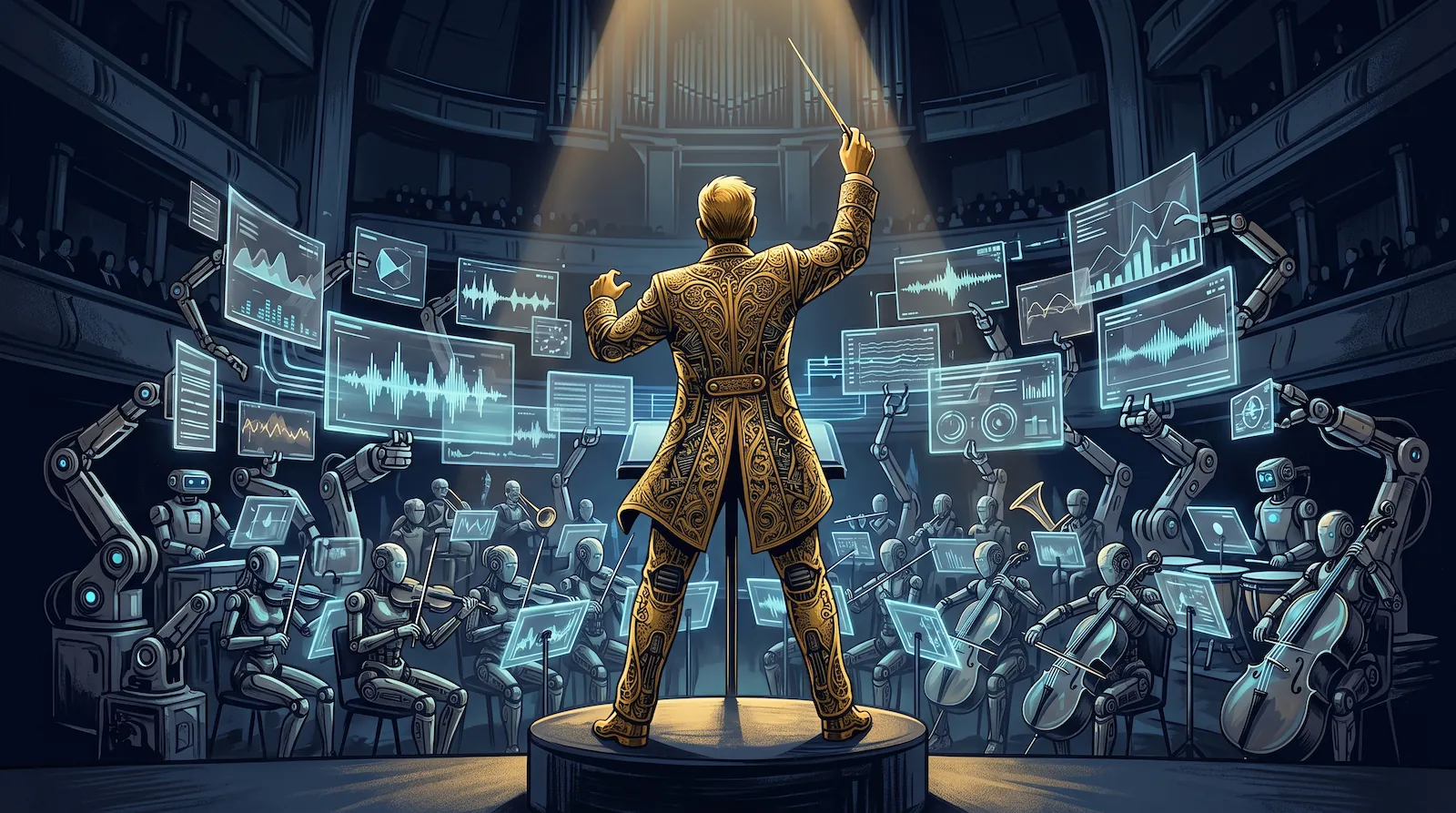
The Solo-Unicorn is the Blueprint’s name for a new class of music entrepreneur: a single operator who replaces the traditional artist team — managers, publicists, creative directors, admin staff — with a stack of AI agents and automated systems, ceasing to be the operation’s sole laborer and becoming its Conductor. The report noted that industry leaders, including OpenAI’s Sam Altman, have predicted the first one-person billion-dollar company will emerge from exactly this kind of creative-sector leverage.
Whether or not anyone hits the unicorn number, the structural shift underneath the prediction is already here, and it’s the part that matters for a working producer. The Blueprint’s market analysis found value migrating decisively from execution — hours worked, manual editing, technical labor — to vision: the Director role, the person who orchestrates brand voice, campaign architecture, and final quality control across systems that do the executing. The manual skills that commanded high day-rates a decade ago are the exact skills the machines commoditized first. The only skill that appreciates in this economy is judgment.
If that sounds familiar, it should: it’s the same inversion this publication documents in the studio. The machine took over competent output; the human premium moved to taste, direction, and the unfakeable performance. The Solo-Unicorn is the business-model expression of the Bionic principle — machine speed everywhere in the operation, human judgment as the product.
The roster of ghosts
The Blueprint also documented the model’s extreme edge, and this is where the serialization owes you a harder read than the original gave. The report described the “AI Auteur” path: one entrepreneur managing a roster of fully synthetic artist personas — a virtual K-pop idol, a lo-fi avatar, a metal band that doesn’t exist — collecting revenue across genres with no touring and no burnout. And the market signal was real: Imoliver became the first AI music creator signed to a major deal; Anna Indiana performed, wrote, and promoted with no human in the loop.
Here’s what a year of enforcement infrastructure added to that picture: a roster of synthetic artists is, in this publication’s terms, a portfolio of Ghost catalogs — inventory that is largely unregistrable, permanently watermarked, disclosed at every upload gate, and living entirely at the mercy of platform policy toward generated content. That model can absolutely generate revenue. What it cannot generate is ownable, defensible assets — and the Blueprint’s own asset-protection chapter (the ancestor of our IP Matrix) said as much before the watermark era made it enforceable. The virtual-roster empire is a real business with a brutal structural ceiling: it scales inventory, but it does not scale property.
The conductor’s actual instrument
The durable version of the Solo-Unicorn keeps the org chart and fixes the product. One person, conducting: research systems doing reconnaissance, generative tools doing pre-production, automation doing distribution and administration — and human hands doing the one thing that produces an appreciating asset: the verified performance. The stack replaces the entourage; it doesn’t replace the author. That’s the difference between operating a content mill with your name on it and running an empire that accrues property.
The Blueprint was right that the team of the next decade is mostly software. The question it left open — and the Matrix answered — is what the software should be for.