Visual Hegemony: Hyper-Real vs. Hyper-Synthetic
Music is a visual medium now — and the most expensive bottleneck in an independent career just collapsed. The Blueprint mapped the two aesthetics fighting for the feed, and the honest lane between them.

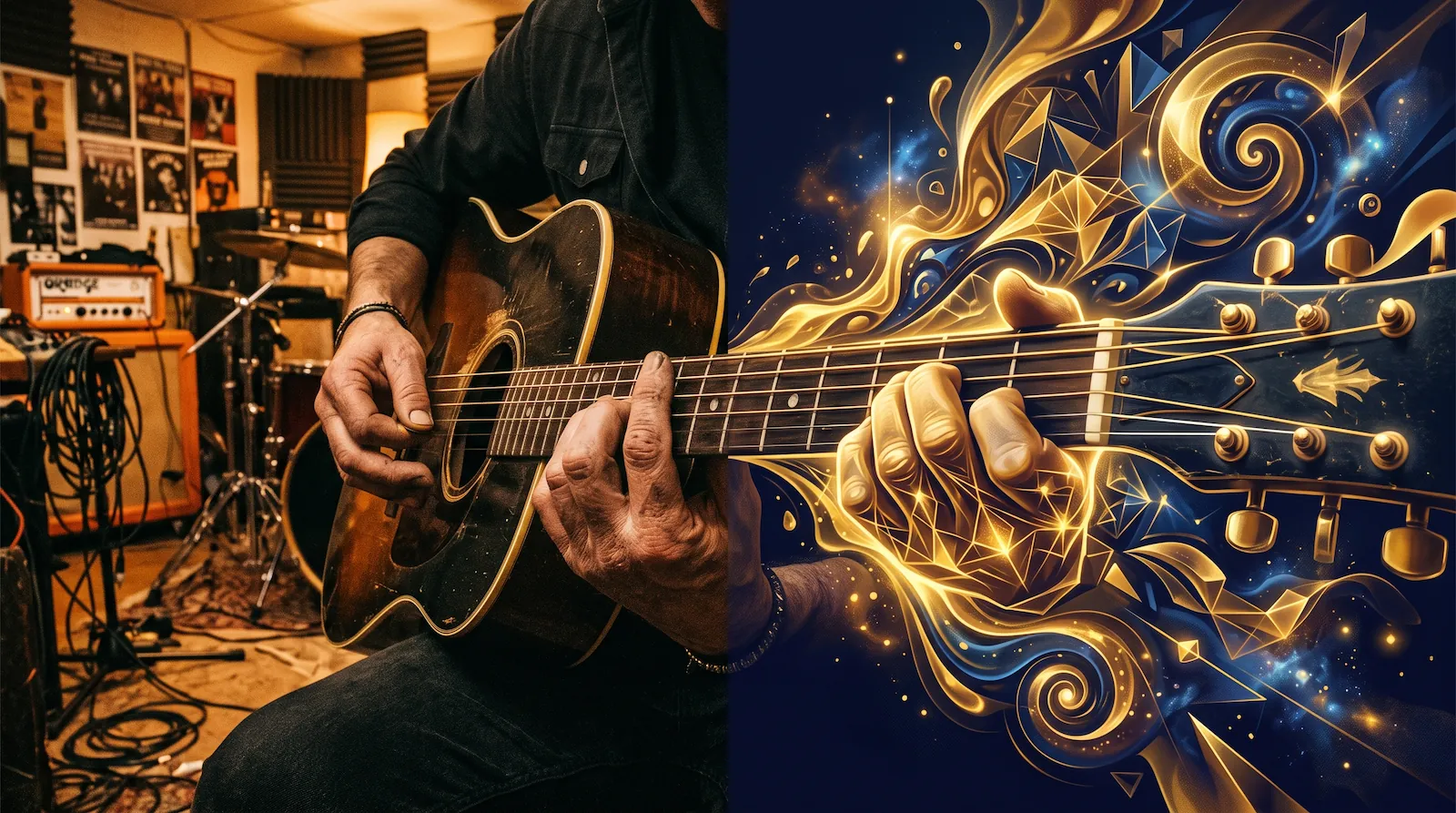
The Blueprint’s visual chapter opened with a claim every working producer already knows in their bones: in the modern attention economy, music is primarily a visual medium. Discovery happens in vertical feeds. The song’s first impression is a frame. And for the independent, broadcast-quality visuals were historically the most expensive bottleneck in the entire career — the place where label money bought what talent couldn’t.
That bottleneck collapsed. Generative video tooling cut the cost of high-fidelity visuals to a fraction of traditional production, and the market bifurcated — the report’s word again, the same fault line as the music itself — into two competing aesthetics.
Hyper-Real: documentary-style authenticity. Live takes, real rooms, visible sweat — the visual language of proof, thriving for the same reason the Hyper-Authentic economy thrives in audio: scarcity of the verifiably human.
Hyper-Synthetic: the AI Auteur aesthetic. Creators wielding multimodal models to build visual narratives that would be fiscally impossible to shoot — leaning deliberately into hyper-surrealism, morphing transitions, dreamlike physics: the native artifacts of diffusion models, worn as style rather than hidden as flaws. The Blueprint flagged tooling like Dzine solving character consistency across frames, taming the flicker that made early AI video unusable.
The honest lane
Here’s the sharpest thing the bifurcation teaches, and it took the audio side’s watermark drama to make it visible: the two aesthetics are not enemies — they are both fundamentally honest. The documentary clip says, “This actually happened.” The surrealist AI video says, “This could never happen, and that is exactly the point.” Each declares what it is. The only losing position on the visual chessboard is the dishonest middle — synthetic footage passing itself off as real performance, the visual equivalent of an undisclosed Ghost track. Audiences punish discovered fakery in video for the same reason platforms punish it in audio, and disclosure regimes for synthetic media are arriving on the same regulatory schedule as the audio rules.
For the producer running a Bionic operation, the visual doctrine writes itself, because it’s the same doctrine. The performance content — you, playing, singing, in a room — is Hyper-Real and is itself proof of humanity: the visual layer of the provenance story this publication keeps telling. The world-building content — lyric videos, visualizers, imagined narratives — can be as Hyper-Synthetic as taste allows, disclosed and intentional, machine speed with your direction. Real when it claims real. Openly synthetic when it dreams. Never the counterfeit middle.
The strategic gift
Don’t miss what the cost collapse actually means for the squeeze the Blueprint mapped in The Great Squeeze →. The visual bottleneck was the last structural advantage label budgets held over independents — and it’s gone. A solo operation can now ship a visual identity that competed at six figures a few years ago: consistent characters, cinematic worlds, release-cadence video output, all conducted by one person with taste. The middle class of the industry lost its safety, but it also lost its excuses. The tools that flooded the market with synthetic noise are the same tools that let a verified human artist look like the empire they’re building.
The Blueprint called visual dominance a hegemony worth seizing. One year on, the price of seizing it has never been lower — and the premium on being real inside it has never been higher.